In the NSW railway hierarchy of importance, keeping the trains running on time was sacrosanct.
A couple of years after graduation I was assigned to the construction office in Sydenham, on the Illawarra line, to work as a project engineer under Gordon Vogan. All construction work for State Rail was run out of this office. There were four relatively young engineers who were assigned to the current construction sites around the state. This was considered training by the management as a fore runner to being assigned to the main operations. We were expected to manage the work which was largely carried out by day labour. Also we were required to do the necessary survey set outs for the construction. We each had a driver/chainman assigned to us to support our work.
I was assigned to a major project to develop the electrification of the Liverpool to Campbelltown line south west of Sydney. It is a part of the main link between Sydney and Melbourne. The work included the upgrade of seven railway stations and the construction of a ninety span flood plain bridge at Minto.
For the electrification program, we had developed a work train to install the overhead structures to support the new electric wires. At the front of the work train a boring machine dug a hole for the foundation. The holes were dug at about 50 metre intervals. Next, a steel RSJ (rolled steel joist) was inserted in the hole and supported by a crane until coarse blue metal was poured around the steel. This gave it enough support so the crane could be released. Next, a slurry of cement was injected to finish the foundation and leave a steel pole to which, in a later operation, the cantilever and dropper for the electrical apparatus could be clamped. The plan was to erect 20 of these per day.
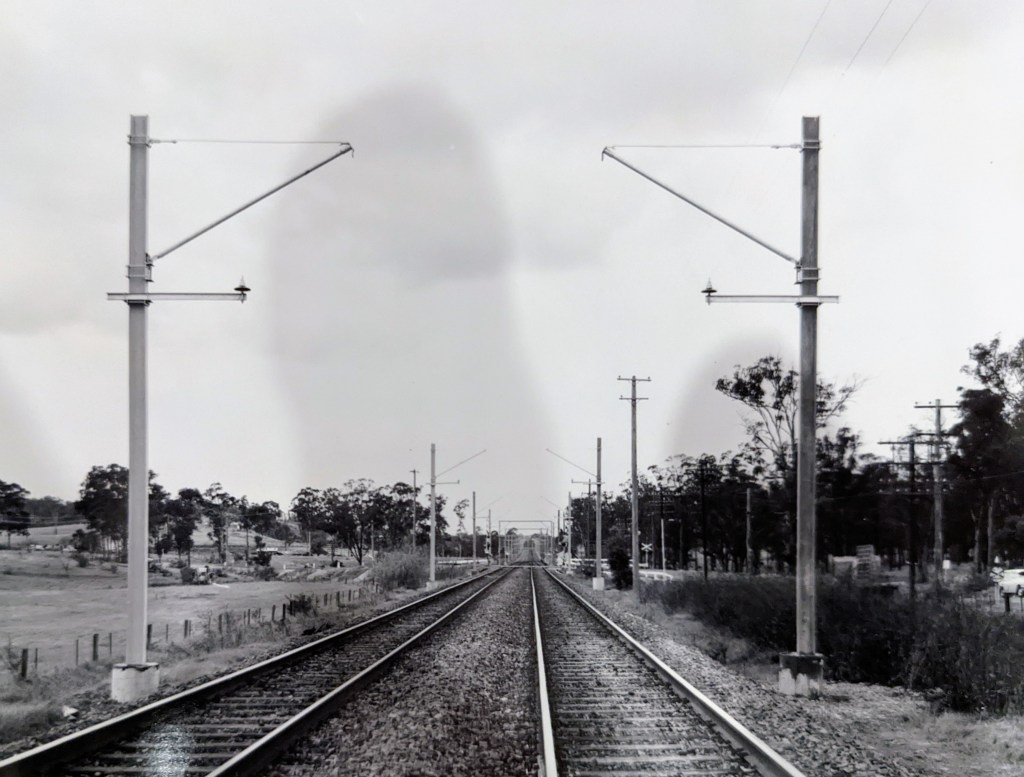
I teamed with traffic manager Ron Tidyman to get the work done and keep the trains running. After a couple of months it was clear that we might never finish. There were twin tracks. For four hours per day we were supposed to have possession of one track. However, when the crane was swivelled to hold the steel pole it ‘fouled’ the second track and trains couldn’t pass. Ron accepted that we might stop suburban trains for a minute or so, but that was it. The reality was very different. Our train was delayed almost every day by traffic restrictions, so we only had two or three hours in which to work. Sometimes the train was marshalled with the carriages in the wrong order, which meant we could do no work. I tried to reason with Ron. He said he didn’t care if we ever finished. I discussed the situation with the foreman. Clem was philosophical ‘ You can’t beat traffic. We are at their mercy.’ We improved the marshalling problem, but our productivity was still low. Under these conditions we would be years late and costs would balloon enormously. Ron had no interest in our problems.
One morning, after more delays, we were finally underway. Then Ron came over: ‘The Southern Aurora is coming! You need to shut down for half an hour.’ No, let me know when it’s close, and we’ll see. Oh and by the way, it should have come by early in the morning,’ I said. He fumed. ‘You know you can get the sack for stopping it!’ ‘It must be very late and a few extra minutes won’t hurt,’ I said. I thought Ron would burst – his face was red and the idea that I would stop the train was apparently unthinkable. I stood my ground and he turned on his heel. I told the foreman to ignore Ron and complete the installation. The train came and was delayed about five minutes. Ron stormed off to write his report. ‘That’s the end of you!’ I heard him shout in the distance. Hmmm. Soon after I went back to the office and made some calculations. If we continued, the costs would blow out from $78 million to $288 million, and it would take an extra three years to complete. I typed up my report and went home.
In the morning there was a summons to appear in the commissioner’s office at 10am at Railway House, Wynyard. I donned my jacket and headed in with my report. Ron was in the anteroom, glaring at me. ‘I warned you,’ he said. ‘Nobody stops the Southern Aurora and gets away with it.’ We were summoned into a large, ornate room, and I got my first look at the stern visage of Commissioner McCusker. ‘Ron,’ he said – they seemed to be on first-name terms – ‘what happened?’ Ron ran through the whole scenario accurately; I was impressed. The commissioner turned to me. ‘What do you have to say, young fellow?’
‘$210 million, sir.’ I replied, pausing for effect. ‘That’s what it will cost extra if we don’t change our operations.’ ‘I don’t understand,’ he said. ‘Well, it will take three extra years and the extra money.’ ‘I still don’t understand,’ the commissioner said. I showed him a schedule and some of my calculations. ‘I’ve never seen anything like this,’ he said, looking at Ron. ‘Are you aware of this? It’s serious.’ Ron suddenly realised that his story was falling apart. The focus had shifted to time and cost. His job was to keep the trains running, not to worry about anything else. ‘Sir, I just wanted to get the Aurora past. Grahame refused to let it,’ Ron said.
The commissioner turned to me. ‘You should have come to me earlier. I’ll get someone to review your report and we’ll issue some new directives. And by the way, don’t stop the Aurora again – it’s bad for publicity. You’re both dismissed.’ I looked at Ron and we trooped out. He was shattered. I still had my job. I actually felt sorry for him. He was at the end of his career, was on first-name terms with the commissioner and I had won the battle.
A few hours later I received a call from my boss, Gordon Vogan. ‘What have you done to the commissioner?’ ‘Nothing.’ Gordon’s voice went up a notch ‘He just called and wants a detailed report on the electrification. He said the budget is blown. We don’t normally involve the commissioner with the details.’
‘I told him it was over by $210 million.’ ‘Why?’ ‘Because I stopped the Aurora for five minutes.’ ‘Christ, you didn’t, did you?’ ‘Yes.’ Silence…. ‘This is serious. You could lose your job for that … and mine too!’ ‘I told him it would be three years late.’ ‘Grahame, what’s got into you? All you have to do is follow the rules, and stopping the Aurora is out of the question.’ ‘Well, it’s been stopped and the commissioner wants a more detailed report.’ ‘What do you mean, more detailed?’ ‘I’ve already given him a summary report, and he was very interested.’ ‘You’ve seen him? You must tell me about these things before they get out of hand. What did you tell him?’ ‘That it will be over budget $210 million and three years late unless he gets Traffic to be sensible.’ ‘Keeping the trains on time is his main mission,’ said Gordon. ‘I don’t think I can save you. Be in my office first thing in the morning.’
I explained to Gordon the theories on planning I had learned at university with my post graduate work and how we could reschedule some of the activities to make up ground. Concrete pumping had just been commercialised and there were a few pumps available for trial. We needed to check that the concrete could be placed without segregation, which is when the cement separates from the aggregate. Gordon listened intently. ‘Now, about this meeting with the commissioner …’ said Gordon. I replied, ‘I told him we can develop a plan to get things back on track if the traffic people assist with the available track time.’ Gordon looked glum. ‘I’ve been here 25 years and I think you’re wrong, OK, if I go so be it.’
I now had my chance to try the concrete pumping technology. Several sections of the work did not allow for the erection of our standard foundation. Conventional concrete foundations were needed, due to rock. The inaccessibility posed problems of getting concrete to the locations. Pumps were expensive, but shutting down the railway track and doing weekend work was too. I wanted to see how far we could pump and still produce quality concrete. After our trials with the pumps I set up a major pour near Glenfield. We had 300 men positioned and three pumps organised. I planned to pour 400 cu metres for the day, starting at six thirty am. I was told I had to use Marley concrete; Marley had the government contract. I called the company and set it up. Next morning on-site we waited. At six forty five the Marley concrete delivery was late. Des, my supervisor, came over agitated. ‘They’re on strike. When the men heard of the big order, they walked out.’
Christ, who else supplies concrete? I raced back to the hut, rang Pioneer Concrete and asked the manager when they could get the first truck out. ‘Seven-thirty.’ I gave him the spec. ‘Can you do 400 cu metres?’ ‘Yes.’ ‘Go for it!’ I told him. I returned to the men. ‘They’ll be here at 7.30.’ ‘Who?’ Des asked. ‘Pioneer.’ ‘You can’t do that! We don’t have a contract.’ ‘Well, it’s done. Get the men ready.’
By 10.30am we had completed two thirds of the pour. Des approached and said, ‘Marley is back at work. Should I call?… went back when they heard Pioneer was doing it’. ‘Are we set up for tomorrow to do another 400?’ I asked, ‘Yes.’ he responded ‘Call Marley and tell them.’ Des was back in ten minutes. ‘We should have put the order in before 10am. It’s in the contract, and they’re dirty because you went to Pioneer and want to put you in your place.’ I went back to the construction shed and rang Pioneer. ‘Can you do another 400 tomorrow, six thirty start?’ ‘No probs.’ I thought … in for a penny, in for a pound.
The following day the district engineer, Doug Neil, stopped by to watch the pumping, which was going very well. I was unaware at the time but this was the first major use of concrete pumping in Australia. The men enjoyed it, as it removed a lot of hard work. ‘Grahame, I notice you’re using Pioneer? They’re not our supplier. Marley have the contract.’ ‘Did they call you?’ I replied. ‘Yes, pretty upset, to say the least.’ ‘Well, suppliers are supposed to supply. They didn’t. If they get their act together, we’ll use them next time.’ ‘Grahame, this is a hanging offence in the railways – you’ve spent $80,000 without authority.’ ‘Yes, but I’ve saved more than that with the new system.’ I went back to the office to write my ‘cover your arse’ report and plan the next attack on the schedule. Surprisingly, I didn’t hear any more about it for several weeks. Then Gordon Vogan called me into his office and showed me an invoice from Pioneer concrete. ‘It’s only $1 a metre more than Marley, but don’t do it again.’ It was a mild rebuke and I asked if he’d seen the pumping and showed him my new schedule. ‘I think we can bring this back to the original plan but I’ll need Traffic to cooperate.’ ‘Don’t worry, the commissioner’s watching very closely and Ron Tidyman is under orders to cooperate.’
To speed up the project, I had a plan to bring on extra crews and work Sundays when rail traffic was light. I discussed it with the sub-foremen and they liked the idea of earning extra pay because Christmas was coming. We devised new procedures to install foundations in major cuttings. One Sunday, south of Campbelltown, I walked into a major cutting to see men suspended from ropes guiding concrete buckets down the face. I was shocked. It was drizzling rain and very slippery. The concrete transit trucks were on crude tracks at the top of the cutting. I ran to the subbie, Matt Blessington. ‘Stop everything!’ He looked at me, nonplussed. ‘You said you wanted to accelerate the program.’
‘Matt, it’s too dangerous. Stop everything now.’ The next morning I called all the sub-foremen to a meeting at the field office in Campbelltown. I explained that all innovations for special works would require a work plan and a run-through of the logistics. I emphasised that we would meet the schedule and that I would try to have them paid a bonus for finishing before Christmas.
For the first time in my life I realised safety had to be number one in any work plan. It was a revelation for me, as I had thought that all workers would realise this and act accordingly, but men look to the leaders to show them the way and rely on their judgement.
Grahame Campbell 16/3/2022
 Grahame Campbell