Computers

When I was an under graduate at UNSW in the early ’60s I used a slide rule as my main calculator for engineering problems. I had no idea until recently that I was in the analog world. By the second half of the 60’s I was carting around boxes of punch cards for my post graduate work. The idea of the digital world was not front of mind. I’ve discovered that engineers don’t think about the foundations of mathematics, they just use the best tools available at the time.

I’ve just finished reading Turing’s Cathedral by George Dyson and was fascinated by the battle between mathematicians and engineers to develop the first digital computer a decade earlier in the 50’s.

Von Neumann( mathematician) and Bigelow( engineer) as the senior members of a team at Princeton Uni in the USA managed to build the first digital computer against the odds. I was the beneficiary in 1970 when I was running large transient flow models for natural gas transmission on a UNIVAC 1108 machine in Sydney.

I only mention this because Freeman’s book opened my eyes to a whole new world of the computer in 2020.

Analog vs Digital has become the topic of the day. We hear about quantum computing but nobody says where it fits ( it’s analog). We have traversed a great circle from analog to digital and back again, in 70 years. In truth the future will be a mix of the two but you have to learn about the strengths of each to take maximum benefit.

Rahul Sarpeshkar gives a great talk on TedX on Analog Supercomputers https://youtu.be/ZycidN_GYo0

Consulting Engineer contracts to Build, Own and Operate a Toll Road

51-LVhLPexL._SX327_BO1,204,203,200_

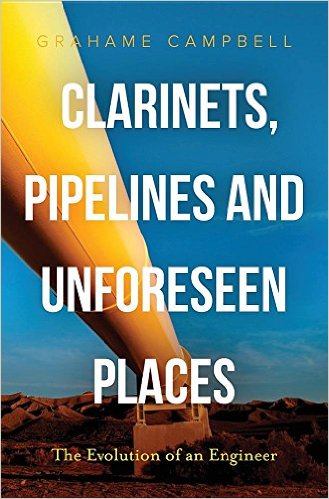
In the late ’80s CMPS the largest Consulting Engineer in Australia at that time decided to form a subsidiary State Wide Roads (SWR) to tender for the right to build, own and operate the first private toll road of the modern era. Grahame Campbell describes in his book ‘Clarinets, Pipelines and Unforeseen Places’ the road that took him to that position. The changing landscape for engineering delivery in Australia was the main driver. The following is an extract from the book describing that critical moment.

‘The SWR board met to review our position with the roads authority. Various government agencies needed to sign off on the details of the road design and the bank confirmed our loan arrangements. Statewide Roads had overcome all the questions posed by the legal reviews. A week later we were advised that Premier Nick Greiner was ready to sign a contract. Alan and his team had achieved a major coup. However, a huge job lay in front of them to deliver on the promises we had made. the greatest day in the 75-year history of CMPS was upon us.

Unfortunately, most people in the company had no idea of the importance of this win. In a strange way, it attacked the basis on which the company had been founded. The independent ‘consulting engineer’ providing dispassionate advice to clients had become the major shareholder in a toll road. We had crossed a boundary, in a sense, but the journey had started much earlier. Our main competitors were international contractors who were hard-headed businesses. The idea of professional independence was not part of their history. My forays into advertising a few years earlier had highlighted the divergence. I still believed our strength lay in our professionalism and fought hard to convince our clients that their welfare was our principal objective.’

A Career in Transition

In my book ‘ Clarinets, Pipelines and Unforeseen Places’ I reflect on a critical career change.I had just returned from a bad experience in the jungles of Suluwesi Indonesia.

Man“………On return, I asked my boss, Kevin Napier, for another assignment. Kevin was sympathetic, and we discussed the various projects in the office. I wrote some clean-up reports for Indonesia and waited. A week later Kevin came to my office with an unusual request. ‘Grahame, you are the only person in the group with computer modelling experience. We have won a contract in joint venture with an American company from Oklahoma, Williams Bros (WB), to build a pipeline to carry natural gas from Bass Strait in Victoria to Sydney along the east coast. They were looking for someone with computer experience to work with the Tulsa engineers, to run computer models for the transmission design studies. Is it something you would like to consider?’

After the misery of Indonesia, this was wonderful. I was keen to work with the Americans, and I accepted on the spot. I had been out of the design role for about five years but had continued to try to understand the design processes, because my project structuring duties demanded it. In fact, I had been exposed to all the disciplines and the interactions required to deliver a complete design. Gas transmission technology would be an exciting new area.

I had spent about six years learning about the structure of projects. How do they start, who are the players and how they are managed. The railways had almost no management systems. They proceeded at their own pace and sometimes responded to prodding if the politics demanded. I was pleased to experiment with new skills from my studies, but I was in uncharted waters. The move to the commercial world snapped me into a new reality. Cost and time needed close attention. Working with suppliers and subcontractors and second guessing their abilities was paramount. Understanding construction methodologies and using new techniques was the difference between success and failure. I felt I had a good grasp until I went to Melbourne and walked into the world of consulting engineering. It was a world in which I would eventually complete my full-time career but at the outset I was nonplussed. I had acquired new skills in computing and system analysis and been told the old ways were proven and best. I was confronted with an elitist attitude I had never struck before.

Next I was thrown into a project that had died before it started. I was asked to set up control systems for a contractor who was about to be dismissed. It’s a bit like wading into a swamp that has mud underfoot. It looks OK on the surface, but you aren’t going to get very far walking.

I was fortunate to be presented with a new direction and luck was smiling at me. My next assignment took me into the positive world of new ideas and an industry that was about to change the world radically for the next decade. ”

The book tracks my new direction and explains the opportunities that can present for engineers building a career.