Bungles,Blowouts and Boondoggles

THE ENGINEER’S CLARINET
Andrew Botros
In the end, when you refine the matter to its purest form, gas pipelines brought down the Whitlam government. His minister wanted them all over the country, but Rex Connor couldn’t find the four billion dollars no matter how many nights he slept next to the telex machine. The loose ends evaded him and his department from start to finish.
45 years on and the Federal Government is about to intervene in gas again. Good luck to them. Whether it’s conduits for gas, conduits for oil or conduits for cars, pipelines have troubled governments for half a century and they’ll trouble the current lot too. Energy and roads: dangerous things and de riguer in the national conversation.
If only we understood how to do them better—a way of thinking that could give us command of the detail—there might be a better life for all of us. The price of error still overwhelms us, and we’ve learned little from the case studies of history.
Grahame Campbell sat at the table for much of that history. When Rex Connor wanted pipes, Grahame performed the first national grid studies in 1973. And when NSW built the M4 motorway as Sydney’s first private build-own-operate-transfer road, Grahame was Chair of the company that delivered it ahead of schedule in 1992.
But I had no idea about any of these things when I met him. Engineers are like that: situated viscerally, away from view, building the backbones of the nation. No, I met Grahame because I knew how clarinets worked and Grahame knew how to play them.
Of all the reed instruments a clarinet is uniquely cylindrical. A little like a miniature gas pipeline if you will, but with twenty or so holes in it, driven by a vibrating sliver of southern French cane.
Making them has been a challenge of infinitesimal detail for centuries. The combination of reed and cylinder gives the clarinet the widest tonal range of any woodwind, so there are compromises everywhere to keep each note close to tune. A careless half-millimetre increase in the bore size of the Boosey & Hawkes 1010 line of clarinets, for one example, virtually killed the English clarinet industry. To the ear of an expert on the matter, “they had such incredibly undersized middle twelfths that they could not have been played in any respectable symphony orchestra.” B&H soon stopped production and bought a French maker instead Clarinet playing is just as delicate. Blow the reed too soft and it won’t move; you’ll just get breathy noise in the bore. Blow it too hard and it will completely shut the mouthpiece. Blow at the right pressure and it might still go rogue, squeaking with its own high pitch, disconnected from the rest of the instrument.
Grahame knows there’s nowhere to hide a bum note in a jazz group. “If one person messes up, the whole thing’s messed up, and inconveniencing seventeen other people is pressure enough not to do it.” There’s no scope for shirking responsibility in a team arrangement like that.
In his early 20s, Grahame had to choose between a life in music and a life in engineering. Clarinettists couldn’t make a living without playing the saxophone too, so one night he approached Don Burrows, James Morrison’s mentor. Don wasn’t keen, but Australia’s best tenor player happened to be sitting next to him.
That’s how Grahame met Graeme Lyall, who later directed the jazz school that James Morrison founded in Mount Gambier. The lessons weren’t what Grahame was expecting, trying to perfect single notes played continuously for minutes on end. It wasn’t long before Grahame knew he couldn’t match Lyall’s pursuit of perfection, and engineering won.
People learn a lot from music, but so few make a living from it. So they stoically take their experiences to their day jobs, accrediting music for their creativity, or their brashness, or their work ethic.
Grahame learned a holistic discipline that would guide his whole career: that every detail mattered. Affinity with every note, empathy with every musician; it’s a framework that translates quite well to the big things we build.
Dundas Corbet Gore led the construction of the Sydney Opera House shells, the twentieth century’s icon of structural complexity. Throughout the placement of every rib and every tile along those 500-foot diameter spheres, suspended above Bennelong Point to within an inch, Corbet was indefatigable. When the NSW Government first insisted that Jørn Utzon’s interiors go to tender, Corbet was the sole exception. Having Corbet start early during the design phase was the only thing they could agree on.
Ten years later he told Grahame several times that the Opera House was easy compared to Gore’s work on the 1,300 kilometre Moomba to Sydney gas pipeline. Corbet worked on the middle section and Grahame the eastern section. It’s the same pipeline that brings natural gas from South Australia’s Cooper Basin to the eastern gas market today.
AGL started the project, but in 1973 Rex Connor nationalised most of it by shutting down AGL’s ability to borrow money from overseas (surely one of the greatest ironies in Australian history). In those days Australian banks had few ideas on how to fund an infrastructure project, so AGL had no choice but to hand over the project to Connor’s department.
Grahame was consulting for AGL and he soon got a phone call from the Treasurer’s office. How much did he think the pipeline would cost that financial year? Grahame was bemused: Connor hadn’t even decided how much of the pipeline he wanted to build, but he gave a speculative guess anyway.
Then there it was in Frank Crean’s budget: exactly $107 million. It was lesson number one. Grahame never forgot how crude and disconnected the whole process could be. There was little commitment to understand gas markets back then, and there are echoes of the same mistakes today.
Government intervention wasn’t the only policy to overcome. Pipeline diameters were just as critical as clarinet diameters, but for completely different reasons. Australian mills made up to 30-inch pipe, but Japanese pipe was half the price and better quality. A 28-inch pipe was needed, but a 34-inch pipe for the main line—80% of the project—was designed to avoid the tariff. BHP and others complained bitterly, but the government wasn’t interested in the big end of town that time.
By 1976 Grahame was managing the eastern section of the pipeline, and it equated to seven days a week of abuse for an entire year. When he took over, The Pipeline Authority (the feds) were irate about coating issues on completed parts of the main line, risking tens of millions of dollars, and AGL wanted answers on the 190 kilometres of pipe sitting in a yard with defective UV coating. The loose ends had been untouched for months.
Then there were the regulations to deal with. “The fire and water authorities wanted trails maintained for access but fitted with gates to deter trail bike riders. The environmental authorities wanted them all eliminated and covered in slow growing native plants. The mines department wanted fast growing vegetation to reduce the danger of erosion.”
And then, just before launch, one single dent in the pipeline near southwest Sydney threatened the operation of the entire project. Things are precarious to the end in the energy sector. AGL phoned Grahame every two hours about it. The response was clarinet roulette if you will: increase the gas pressure to a point where the dent might blow out, but not so great as to burst the pipe and kill them all.
The blow was just enough, and Grahame’s team survived, and natural gas arrived in Sydney on New Year’s Eve, 1976, replacing the toxic stuff that used to be produced from coke and coal out of Mortlake. AGL lit a gas flame at the Opera House to celebrate. None of the engineers were invited.
Close all the holes of a clarinet and blow it right. You’ll get its deepest sound, an E below middle C; a column of air vibrating back and forth 165 times a second. Natural gas in the Moomba to Sydney pipeline just flows in one direction at four kilometres an hour. You could walk beside it. It’s hardly a large flow.
“In my view, there’s bookoo gas,” Grahame tells me. I had to look up the term: a southern USA corruption of beaucoup. He’s an oil and gas man after all. The meaning was clear enough: plenty of gas, and plenty of capacity in the pipeline.
I showed him Alan Finkel’s Independent Review into the Future Security of the National Electricity Market to get his opinion on the current gas crisis. He wasn’t impressed. In its place, he gave me a summation of the issue with a simplicity that only a direct and disciplined engagement with the full detail of the matter could enable.
We know that gas producers have ramped up exports since 2015 via liquefied natural gas (LNG) projects in Queensland, exposing the eastern market to exports for the first time. We know that the source is coal seam gas (CSG), the most expensive of any gas to produce. We know that two-thirds of our gas now goes overseas, a ratio the Turnbull government is looking to reduce by force.
But what is not common knowledge is that gas producers have committed to long term contracts of a fixed supply but a variable price. And the bulk of our gas exports go to Asia, where, unlike the domestic market, the gas price is linked to the oil price.
When the investments were made—based on expensive CSG production—the international oil price was US$100 a barrel. The price is now half that amount after sliding in 2014, so the cost of production is now greater than the sale price. That’s after $70 billion has been sunk in the infrastructure.
After my discussions with Grahame I went searching for confirmation beyond the many white papers, reviews and official statistics. Santos provided it to the ASX in August 2017: “Santos has lowered its Brent oil price forecasts to US$50 per barrel in 2017 … As a result of the changes in assumptions, Santos expects to recognise an impairment of Gladstone LNG (GLNG) of approximately US$870 million after tax, predominantly due to lower oil prices.” The GLNG Media Centre hasn’t put out a good news story since May 2016.
Gas companies don’t like making a loss, so who do you think is making up the shortfall? All of us, paying more for the conventional natural gas that’s been coming through the pipelines for decades The Labor Party’s 2012 Energy White Paper warned of “transitional pressures” but made no mention of export prices. Read carefully, however, and there’s a hint of how it all works when there’s a shock to the system: “Recent floods in Queensland slowed CSG production, and some LNG producers have begun to supplement contracted reserves in the ramp-up period from conventional supplies in the Cooper Basin.”
The Coalition’s 2015 Energy White Paper was even less useful. “Increasing supply and improving market function are key to easing these price pressures, but continued movement towards parity with higher international prices are nonetheless inevitable.” So much for the theory—the domestic price towers above the international price today.
But alarmingly the Finkel review makes the same mistake. “Domestic users in the east coast gas market now compete for additional gas supplies with prices set at a level that competes with the international market.”
We’re left to ask: if none of these reviews can command the basic details of the issue, what chance then for leadership to make the right energy decisions?
It isn’t by chance that Grahame is attuned to export prices. It comes from an outward-looking life in international trade, leading projects in Indonesia, Iraq, Trinidad and the United States. He was CEO of CMPS&F when it was an Australian Exporter of the Year in 1995, but it wasn’t always so for the company. It was a chronic underperformer when Grahame’s tenure began in 1987.
Nick Greiner’s M4 changed the outlook and culture of Grahame’s company. When the NSW Premier wanted a privately built, owned and operated freeway running parallel to the oldest highway in Australia, Grahame wasn’t interested in just the design work. Unlike every other engineering firm, Grahame wanted to own and manage the M4 too.
That strategy challenged an ethical assumption as old as the profession itself: not to dabble in construction and engineering at the same time. “This man is a dentist, so we can’t show you his face on television,” so to speak.
The old principle made no sense. As Grahame put it, clients were starting to ask, “If your designs are competent why don’t you take the construction risk?” Clients wanted complete packages, seamless experiences.
Grahame’s company was one of the first to marry construction with finance in a way that exemplified 1980s deregulation. Australian banks weren’t afraid to take a risk on an infrastructure project by then, so the Commonwealth Bank provided 100% of the debt to the CMPS subsidiary, StateWide Roads, in return for only a 12.5% preference share. CMPS put in a mere one million dollars. They all made a killing. By the time Macquarie Bank bought up StateWide Roads, the $1 million had become $300 million. Macquarie had already copied the business model, so they bought the prototype too.
It wasn’t the numbers that left an impact on me, but the methods. Not for their sophistication, but for the exact opposite. For their directness, for their flatness.
For a structure that kept senior management close to the bitumen. Alan Livingstone ran StateWide roads, and he’d already led a company that built major infrastructure for the government, including highways. Alan and his team knew who to call and how to talk to them, so they had no need for a principal contractor. It had never been done before. Thirty subcontractors were studied carefully and managed directly. Disputes with residents were handled directly, with a company chequebook in hand. They met with a single banker once a month and otherwise got on with the job.
Who builds like that today? WestConnex includes the M4 widening and M4 East projects, so a brief comparison to the original M4 might be insightful. The current M4 financing arrangements have no less than six creditors: CBA, Crédit Agricole (a French bank with historical ties to farming), ING, NAB, Natixis (another French investment bank) and Westpac. The entire project has been separated from the NSW Government as the Sydney Motorway Corporation. The Treasurer and the portfolio ministers have been reduced to shareholders.
In July 2017 a leaked cabinet document suggested that legal claims by subcontractors had reached $1 billion and the first part of the project, the M4 widening, was behind schedule and over budget. “You just shudder to think what the status will be of the more complex stages of WestConnex,” the Labor Opposition Leader said.
Well it’s a Liberal-National government that’s behind the M4 widening and it was a Liberal-National government that did the original M4. And yet the original M4 was finished nine months early.
Every musician, every note. With an approach to management that directly connects the full team, you’ve got a fighting chance of taking care of the details.
“The great regret of my board roles was that I did not have much support for the project outcomes which was my passion. Directors largely were accountants and lawyers who concentrated on corporate governance and finance issues, their comfort zone. They felt project delivery was a management problem.”
To be fair, Grahame appointed his fair share of accountants and lawyers to his own board. He’s met a few, but then again, he’s also met any number of steam turbine engineers incapable of putting their minds to gas turbines. They all still frustrate him.
In 2004 Malcolm Turnbull tried the ‘corporate doctor’ line to explain why he wasn’t aware of the logging practices of the subsidiary of a company that he chaired. It didn’t go well for him. Too many degrees of separation. Too many details unseen. Lucy Turnbull has suffered the same: as chief of the Greater Sydney Commission in 2016, she was unaware that entire streets of heritage homes in Haberfield were being demolished to make way for WestConnex.
Musicians don’t think like that. “When you start losing detail, whether it’s in music or in life,” said the American clarinettist Benny Goodman, “you start to lose substance.”
Grahame was once asked by his marketing director at Huffco (while working in Trinidad for the Houston-based oil company): “What does playing clarinet for the Trinidad Symphony do for Huffco?” It was more of the same disconnected thinking.
“The president is the patron of the orchestra,” Grahame replied.
“The president of what?”
“The president of the f—ing country! The president knows I run Huffco here, and a word is always welcome on behalf of friends.”
In turn, not a bad way for a president or a prime minister to simply keep in touch with the finer details of a nation. We’ve long realised the importance of social connectedness in Australian life, but when it comes to managing connectedness in Australian workplaces, there’s still so much understanding and self-awareness yet to be grasped. For that omission, we all continue to pay the price.
LEARNING TO BE AN ENGINEER ON THE JOB
In the NSW railway hierarchy of importance, keeping the trains running on time was sacrosanct.
A couple of years after graduation I was assigned to the construction office in Sydenham, on the Illawarra line, to work as a project engineer under Gordon Vogan. All construction work for State Rail was run out of this office. There were four relatively young engineers who were assigned to the current construction sites around the state. This was considered training by the management as a fore runner to being assigned to the main operations. We were expected to manage the work which was largely carried out by day labour. Also we were required to do the necessary survey set outs for the construction. We each had a driver/chainman assigned to us to support our work.
I was assigned to a major project to develop the electrification of the Liverpool to Campbelltown line south west of Sydney. It is a part of the main link between Sydney and Melbourne. The work included the upgrade of seven railway stations and the construction of a ninety span flood plain bridge at Minto.
For the electrification program, we had developed a work train to install the overhead structures to support the new electric wires. At the front of the work train a boring machine dug a hole for the foundation. The holes were dug at about 50 metre intervals. Next, a steel RSJ (rolled steel joist) was inserted in the hole and supported by a crane until coarse blue metal was poured around the steel. This gave it enough support so the crane could be released. Next, a slurry of cement was injected to finish the foundation and leave a steel pole to which, in a later operation, the cantilever and dropper for the electrical apparatus could be clamped. The plan was to erect 20 of these per day.
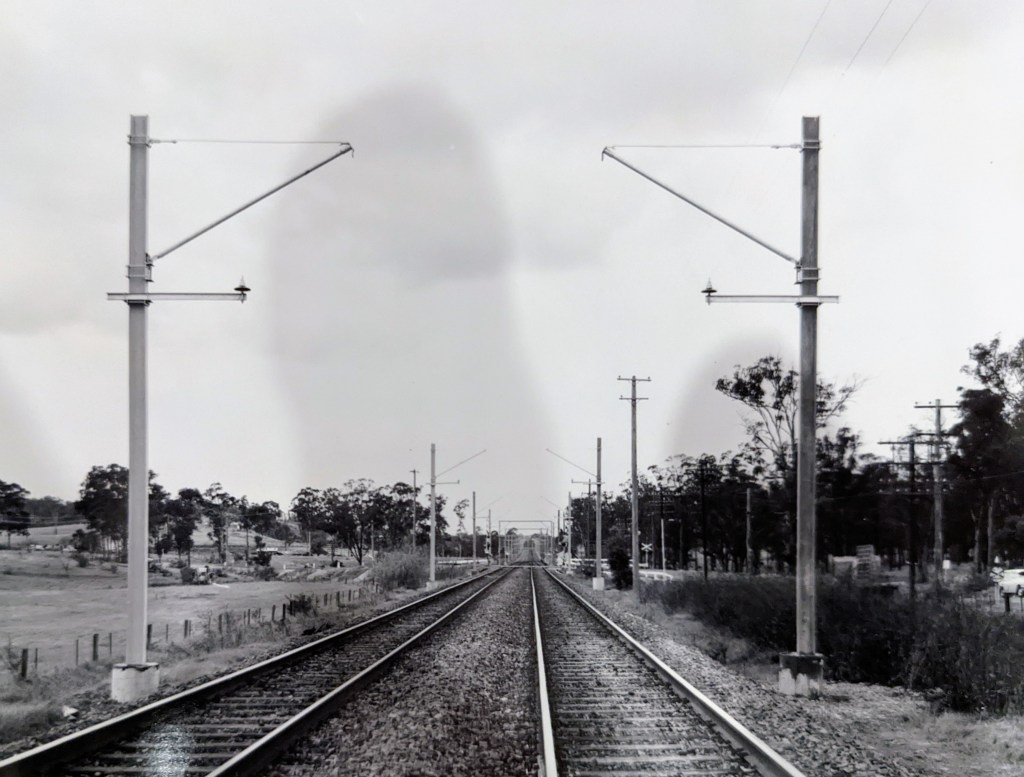
I teamed with traffic manager Ron Tidyman to get the work done and keep the trains running. After a couple of months it was clear that we might never finish. There were twin tracks. For four hours per day we were supposed to have possession of one track. However, when the crane was swivelled to hold the steel pole it ‘fouled’ the second track and trains couldn’t pass. Ron accepted that we might stop suburban trains for a minute or so, but that was it. The reality was very different. Our train was delayed almost every day by traffic restrictions, so we only had two or three hours in which to work. Sometimes the train was marshalled with the carriages in the wrong order, which meant we could do no work. I tried to reason with Ron. He said he didn’t care if we ever finished. I discussed the situation with the foreman. Clem was philosophical ‘ You can’t beat traffic. We are at their mercy.’ We improved the marshalling problem, but our productivity was still low. Under these conditions we would be years late and costs would balloon enormously. Ron had no interest in our problems.
One morning, after more delays, we were finally underway. Then Ron came over: ‘The Southern Aurora is coming! You need to shut down for half an hour.’ No, let me know when it’s close, and we’ll see. Oh and by the way, it should have come by early in the morning,’ I said. He fumed. ‘You know you can get the sack for stopping it!’ ‘It must be very late and a few extra minutes won’t hurt,’ I said. I thought Ron would burst – his face was red and the idea that I would stop the train was apparently unthinkable. I stood my ground and he turned on his heel. I told the foreman to ignore Ron and complete the installation. The train came and was delayed about five minutes. Ron stormed off to write his report. ‘That’s the end of you!’ I heard him shout in the distance. Hmmm. Soon after I went back to the office and made some calculations. If we continued, the costs would blow out from $78 million to $288 million, and it would take an extra three years to complete. I typed up my report and went home.
In the morning there was a summons to appear in the commissioner’s office at 10am at Railway House, Wynyard. I donned my jacket and headed in with my report. Ron was in the anteroom, glaring at me. ‘I warned you,’ he said. ‘Nobody stops the Southern Aurora and gets away with it.’ We were summoned into a large, ornate room, and I got my first look at the stern visage of Commissioner McCusker. ‘Ron,’ he said – they seemed to be on first-name terms – ‘what happened?’ Ron ran through the whole scenario accurately; I was impressed. The commissioner turned to me. ‘What do you have to say, young fellow?’
‘$210 million, sir.’ I replied, pausing for effect. ‘That’s what it will cost extra if we don’t change our operations.’ ‘I don’t understand,’ he said. ‘Well, it will take three extra years and the extra money.’ ‘I still don’t understand,’ the commissioner said. I showed him a schedule and some of my calculations. ‘I’ve never seen anything like this,’ he said, looking at Ron. ‘Are you aware of this? It’s serious.’ Ron suddenly realised that his story was falling apart. The focus had shifted to time and cost. His job was to keep the trains running, not to worry about anything else. ‘Sir, I just wanted to get the Aurora past. Grahame refused to let it,’ Ron said.
The commissioner turned to me. ‘You should have come to me earlier. I’ll get someone to review your report and we’ll issue some new directives. And by the way, don’t stop the Aurora again – it’s bad for publicity. You’re both dismissed.’ I looked at Ron and we trooped out. He was shattered. I still had my job. I actually felt sorry for him. He was at the end of his career, was on first-name terms with the commissioner and I had won the battle.
A few hours later I received a call from my boss, Gordon Vogan. ‘What have you done to the commissioner?’ ‘Nothing.’ Gordon’s voice went up a notch ‘He just called and wants a detailed report on the electrification. He said the budget is blown. We don’t normally involve the commissioner with the details.’
‘I told him it was over by $210 million.’ ‘Why?’ ‘Because I stopped the Aurora for five minutes.’ ‘Christ, you didn’t, did you?’ ‘Yes.’ Silence…. ‘This is serious. You could lose your job for that … and mine too!’ ‘I told him it would be three years late.’ ‘Grahame, what’s got into you? All you have to do is follow the rules, and stopping the Aurora is out of the question.’ ‘Well, it’s been stopped and the commissioner wants a more detailed report.’ ‘What do you mean, more detailed?’ ‘I’ve already given him a summary report, and he was very interested.’ ‘You’ve seen him? You must tell me about these things before they get out of hand. What did you tell him?’ ‘That it will be over budget $210 million and three years late unless he gets Traffic to be sensible.’ ‘Keeping the trains on time is his main mission,’ said Gordon. ‘I don’t think I can save you. Be in my office first thing in the morning.’
I explained to Gordon the theories on planning I had learned at university with my post graduate work and how we could reschedule some of the activities to make up ground. Concrete pumping had just been commercialised and there were a few pumps available for trial. We needed to check that the concrete could be placed without segregation, which is when the cement separates from the aggregate. Gordon listened intently. ‘Now, about this meeting with the commissioner …’ said Gordon. I replied, ‘I told him we can develop a plan to get things back on track if the traffic people assist with the available track time.’ Gordon looked glum. ‘I’ve been here 25 years and I think you’re wrong, OK, if I go so be it.’
I now had my chance to try the concrete pumping technology. Several sections of the work did not allow for the erection of our standard foundation. Conventional concrete foundations were needed, due to rock. The inaccessibility posed problems of getting concrete to the locations. Pumps were expensive, but shutting down the railway track and doing weekend work was too. I wanted to see how far we could pump and still produce quality concrete. After our trials with the pumps I set up a major pour near Glenfield. We had 300 men positioned and three pumps organised. I planned to pour 400 cu metres for the day, starting at six thirty am. I was told I had to use Marley concrete; Marley had the government contract. I called the company and set it up. Next morning on-site we waited. At six forty five the Marley concrete delivery was late. Des, my supervisor, came over agitated. ‘They’re on strike. When the men heard of the big order, they walked out.’
Christ, who else supplies concrete? I raced back to the hut, rang Pioneer Concrete and asked the manager when they could get the first truck out. ‘Seven-thirty.’ I gave him the spec. ‘Can you do 400 cu metres?’ ‘Yes.’ ‘Go for it!’ I told him. I returned to the men. ‘They’ll be here at 7.30.’ ‘Who?’ Des asked. ‘Pioneer.’ ‘You can’t do that! We don’t have a contract.’ ‘Well, it’s done. Get the men ready.’
By 10.30am we had completed two thirds of the pour. Des approached and said, ‘Marley is back at work. Should I call?… went back when they heard Pioneer was doing it’. ‘Are we set up for tomorrow to do another 400?’ I asked, ‘Yes.’ he responded ‘Call Marley and tell them.’ Des was back in ten minutes. ‘We should have put the order in before 10am. It’s in the contract, and they’re dirty because you went to Pioneer and want to put you in your place.’ I went back to the construction shed and rang Pioneer. ‘Can you do another 400 tomorrow, six thirty start?’ ‘No probs.’ I thought … in for a penny, in for a pound.
The following day the district engineer, Doug Neil, stopped by to watch the pumping, which was going very well. I was unaware at the time but this was the first major use of concrete pumping in Australia. The men enjoyed it, as it removed a lot of hard work. ‘Grahame, I notice you’re using Pioneer? They’re not our supplier. Marley have the contract.’ ‘Did they call you?’ I replied. ‘Yes, pretty upset, to say the least.’ ‘Well, suppliers are supposed to supply. They didn’t. If they get their act together, we’ll use them next time.’ ‘Grahame, this is a hanging offence in the railways – you’ve spent $80,000 without authority.’ ‘Yes, but I’ve saved more than that with the new system.’ I went back to the office to write my ‘cover your arse’ report and plan the next attack on the schedule. Surprisingly, I didn’t hear any more about it for several weeks. Then Gordon Vogan called me into his office and showed me an invoice from Pioneer concrete. ‘It’s only $1 a metre more than Marley, but don’t do it again.’ It was a mild rebuke and I asked if he’d seen the pumping and showed him my new schedule. ‘I think we can bring this back to the original plan but I’ll need Traffic to cooperate.’ ‘Don’t worry, the commissioner’s watching very closely and Ron Tidyman is under orders to cooperate.’
To speed up the project, I had a plan to bring on extra crews and work Sundays when rail traffic was light. I discussed it with the sub-foremen and they liked the idea of earning extra pay because Christmas was coming. We devised new procedures to install foundations in major cuttings. One Sunday, south of Campbelltown, I walked into a major cutting to see men suspended from ropes guiding concrete buckets down the face. I was shocked. It was drizzling rain and very slippery. The concrete transit trucks were on crude tracks at the top of the cutting. I ran to the subbie, Matt Blessington. ‘Stop everything!’ He looked at me, nonplussed. ‘You said you wanted to accelerate the program.’
‘Matt, it’s too dangerous. Stop everything now.’ The next morning I called all the sub-foremen to a meeting at the field office in Campbelltown. I explained that all innovations for special works would require a work plan and a run-through of the logistics. I emphasised that we would meet the schedule and that I would try to have them paid a bonus for finishing before Christmas.
For the first time in my life I realised safety had to be number one in any work plan. It was a revelation for me, as I had thought that all workers would realise this and act accordingly, but men look to the leaders to show them the way and rely on their judgement.
Grahame Campbell 16/3/2022
GLOBAL CEMENT CRISIS
THE GLOBALCEMENTCRISIS(GCC)
Dave and John were mulling over the report they received from their friend Eric at Brown Chemicals claiming a new substance that bonds materials with great strength. Eric invited them to the factory in Botany to review his work as he believed this new product could replace traditional cement in concrete manufacture.
Dave and John ran an engineering consultancy, JD Engineers, with offices across Australia. Over the past 25 years they had built the business from a two man partnership into a multi disciplined engineering and management group. They employed 1000’s of engineers designing and managing the development of major infrastructure and buildings. The business had expanded across Australia and up into Asia. They had joint ventures in Europe and North America to share technology and bring their own ideas around the world.
The idea of using ‘cemsure’ ( Eric’s name for the chemical) as a replacement for cement seemed very attractive. Portland cement was a key component in the construction industry but was being attacked by the environmental activitists because of the energy required in its manufacture.
Eric ushered them into the back area of the research department. “My bosses are not very supportive of this work as we are mainly involved in chemicals for the paint industry and they have no interest in construction.” Dave enquired “ how did you come across cemsure?”
I was fiddling with a new additive when it clagged the paint material. I tried different doses and started to understand how it combined with another material that we had been using. Bingo! I then started mixing sand and quickly was able to create high strength bricks. It was then that I thought of you guys as I had little experience with construction materials.
I’ll show you some of the results I have to date. I set them out in the report that I prepared. They all checked the numbers and John noted that the production cost was about a third the cost of portland cement used in concrete manufacture.
“ How do you know you can produce cemsure at this cost? It’s very cheap.”
Eric responded “ The main components are well known and the special additive is something I guessed for price, but it’s small in quantity. We will have to check into that some more. It is sourced from the residue of mineral sands production. The main ingredient of paint comes from the minerals sand industry, that’s why we have been dealing with them. It’s a waste product for them and it can be unstable if mishandled. I believe they will be happy for us to take it off their hands.”
“ What do you mean it’s unstable? Dave asked.
“ If it gets too hot it can be a bit unpredictable, but I’m sure we can manage that.”
A few days later Dave had studied the report in detail and concluded that the potential for cemsure was immense. There was a lot of work to be done.
First a company needed to be established to develop the product and establish a business plan. Who should become equity holders? Where can they get the development money?
Over a beer a couple of weeks later John and Dave discussed the issues.
“ Dave, this is big. If cemsure comes on the market at a third the price of cement it will be a hit” “John, we have a lot of hurdles before it will be accepted. Government, industry, building codes, the engineering profession and safety issues need to be explored. It could take years to get approvals. I’ve started a small group in the back office to lay down a plan and a budget to get us underway.”
Eric was encouraged by our analysis and started to put a manufacturing plan together. In a couple of months he was quizzed by his bosses about the work. He didn’t want to be totally open as it was clearly outside the paint industry. He had a dilemma, get their buy in and approval or drop the whole thing. He explained the general idea of his work and received a fairly negative response. What to do.
When John discovered Eric’s situation he knew it was time to act. There was no point in continuing without Eric. He called Dave and talked about formalising the company and a budget. The discovery was too good to let go.
The three of them sat down and agreed a plan. $5 million seed money would be allocated from the engineering business, Eric would be employed as a full time technology leader and an office established in Botany. Six weeks later they convened in the new office to discuss the plan.
Eric had established a source of supply for the feedstock with a mineral sands company who were happy to release the waste material. It was a liability on their books. There were vast quantities of it!
Dave quizzed Eric about the ‘secret ingredient’ that came from this feedstock. “ You said that it can be unstable? “
“Well, one of the chemicals is unstable before it combines but I think it will be OK once the reaction is complete.” Eric spent the next several hours running through the issues and how the ‘instability ‘ could be managed. He explained that it was slightly radioactive due to small amounts of thorium. He believed that he could manage the issues with the mix and produce a simple powder similar to portland cement at a third the cost. An additional benefit was the chemical nature of the process used almost no energy which was becoming a large environmental problem for traditional cement.
Over the next year many tests were run and all interested parties were invited to seminars and demonstrations to view the results. In parallel with traditional concrete manufacture cemsure performed extremely well. It gained strength much quicker as it set and exceeded the 28 day test strength by 30-40 % of portland cement.
Dave was a little concerned about the ‘instability’ that Eric alluded to in the early days. Eric said he had minimised the problem and with good management it shouldn’t be an issue. Dave pressed him a little further. In the longer term, say 10 to 15 years , will it still be stable? Eric said there were no guarantees but he was hopeful that all would be well.
Over the next three years cemsure grew in popularity and government endorsed it as a great contributor to reducing greenhouse gas emissions. The traditional cement suppliers had mounted a broad media attack suggesting that cemsure was an unknown product and had no track record. There were suggestions that the chemical was a health hazard and tried to compare it to asbestos. They claimed the radioactivity would be harmful to children. The media had a field day for a year but ran out of steam when each claim was carefully rebuffed and the environmental benefits were put to the fore.
Cemsure corporation now had 100 employees and purchase agreements were concluded for large quantities of monazite from the waste dumps owned by the mineral sands industry.
The portland cement producers were cutting prices but could not compete with cemsure.
The cemsure owners were at the crossroads. Do they float the company or sell to the traditional suppliers. It could turn into a billion dollar venture and go global. They needed $80 million to establish a manufacturing plant in western Sydney and had no problem raising the debt required. The bankers were impressed with the penetration of the market in Australia which had reached 30% and of course noticed the positive press about the low carbon footprint of the product.
In 18 months the new plant came into production and could satify demand for Australia and SE Asia. Growth in Asia was very strong, more driven by the price advantage.
Dave tackled Eric again. How can we put this instability issue to bed. Are there tests, can we get some atomic analysis? Eric understood the question and it had been bothering him too. If cemsure is hugely successful and thousands of bridges and buildings are constructed will they still be competent to survive with this potential ‘instability’ however small an issue it might be.
The market had not been advised of this potential as in the early days the work had concentrated on supply chains and production issues.
Dave shared his concerns with John who had taken the chairman’s role for the company.
“ John, there is a chance that our product could fail in 10-15 years due to an instability, possibly due the small amount of radioactive substance that Eric mentioned. He doesn’t seem worried but I’m feeling we should advise the market.”
John’s response was surprising. “ We don’t know if there is a problem. Everybody loves the product and we stand to make hundreds of millions of dollars if we go forward. Eric said the chance of failure is extremely small and the world will have improved the climate change problem with our near zero emissions product. I think you are worrying too much.”
Dave thought about it over his next two beers.
“ John, do you remember the GFC around 2008. The bankers were trying to expand their business by changing the risk profile of their lending programs. They took on high risk loans which they then collateralised into a new product, mortgage backed secutities (MBS). The rating agencies, the S&P’s of the world, then gave the new product investment grade status. They didn’t look closely at the long term stability and that lit the fuse for the explosion many years later in 2008. The initiators of this scheme knew the risks but didn’t tell the market. In fact they made the whole game more complicated by creating collaterised debt obligations (CDO) . Not happy with that they they finally made matters more complicated by developing credit default swaps (CDS) another financial derivative, to insure against defaults on CDO’s Their attitude seemed to be, by the time they find out what is going on we will be long gone with our profits. Isn’t this the same situation?”
John responded, “ Well, no one was charged or went to jail. The government just took tax payers money, trillions I know, and tried to put the system back to normal. “
“ John, you are missing the point, thousands of people committed suicide and millions were left destitute. It was a massive calamity for the world. If our product fails bridges will collapse and buildings will crumble with many deaths. People won’t buy the argument that we thought it was a miniscule risk and worth taking. Engineers are held to a higher standard.”
“ Dave, after the GFC the government imposed major restrictions on financial institutions to guarantee it wont happen again. If there are future problems we would have sold the company and moved on. I don’t want to forgo this opportunity to become mega rich, we’ve worked hard for it.”
Dave was troubled but accepted the Chairman’s position and returned to the problem of their massive expansion. He met with Eric to finalise the production schedules and supply chain issues. The chemical process was the key that Eric had developed. It couldn’t be reverse engineered as the elements seemed to disappear after reaction. Once the product was in the bag only Eric knew how the process had occurred. Competitors couldn’t reproduce an alternative.
Over the century concrete had had a chequered history. Mixing techniques had led to very poor strength and quality issues. 40 years ago ‘concrete cancer’ had emerged as a major problem. This was caused by air pollution in cities, ‘acid rain’, penetrating concrete and rusting the steel reinforcement. This was solved by putting a chemical in the mix which entrained the miniscule air bubbles and stopped water penetration. However thousands of structures were poorly built and needed major refurbishment.
In another case, to increase production rates for precast products aluminium powder was added to the mix to accelerate the curing. The downside was discovered when a shipload of concrete piles on its way to the tropics had disintegrated en route due to the high temperatures and humidity in the hold.
Concrete is valuable because of it’s compressive strength, it has little tensile strength and requires steel reinforcement to be useful as a structural component. It takes a month to reach it’s working strength and continues to cure for a long period of time. Cemsure in concrete reaches higher strengths quicker than portland cement. However its long term stability is unknown.
The general industry was aware of this and traditional concrete manufacturers were against
cemsure. The building industry was in favour because of the low cost and higher strengths. The issue of acceptance was finally resolved by the environment activists who demonstrated strongly outside parliament to convince the government to urgently approve the product generally.
Cemsure was established in Australia and now needed to develop a strategy for global acceptance. John had approached ready mix concrete companies in Europe and the USA. JD Engineering’s partners had facilitated this. Their relationships with the various governments had added confidence to the market. The plan was to do all manufacture in Australia as the raw materials were available in bulk for decades to come. A team initially went to the US to demonstrate the competitiveness of the product against portland cement. Transport costs were an impact but were relatively small. Although improved strength was a feature the much lower cost was the main selling point.Various tests were set by the building authorities and came through with flying colours. Many questions were asked about its durability and stability. Dave had written a sales document which alluded to long life for the product. He stated that there was no information that would suggest that it was unstable. This was true but it had only been around a few years.
After six months all Federal and State governments in the US and Canada had approved cemsure for use in concrete. This was very fast for the authorities but a strong push by the environment movement had fast tracked the progress.
Cemsure now needed $500 million to build an expanded manufacturing facility for world supply. John had talked to financiers who were falling over themselves to participate. The facility itself would be designed and managed by JD Engineers as it was their bread and butter work.
Within two years cemsure had taken 60% of the market in Australia and 15% of the USA. Sales were growing at 5% per month and were over $5 billion globally.
The three investors had been able to hold onto all the shares in Cemsure and largely fund development with debt. When they floated the company on the ASX they only released 30% of the stock to the public so they could keep control and keep the chemical process secret from competitors. The value of the company went into the many billions of dollars.
A couple of years later over dinner John, Dave and Eric were enjoying the success as the stock in Cemsure Corporation had made them billionaires. Eric was toying with his wine when he announced that a building owner in Darwin had called to say his building columns had some small cracks down the vertical line. It was only three storeys but was one of the first to use cemsure. Dave pricked up his ears. “ How did he know to call you?”
Eric responded “ The builder was one of the first of our customers when we were doing the tests. We let him have the product for free to get going.”
Dave asked “ That was about 7 years ago. Did the hot, humid weather contribute?”
“ I’m heading up there next week to do some tests, we should know more in a month or so.” Dave glanced at Eric “Are you worried?”
“ Not really, it could be anything.”
During the next management meeting Eric shared the results of the Darwin tests.
“It’s a bit inconclusive but there has been some deterioration of the cement, it seems to have contracted slightly. We are carrying out tests to accelerate the durability issues. It will take a month before we can reach any conclusions.”
Dave asked “ do we need to stop production of cemshare, while we wait for the answers?”
John interjected “ it’s too early to draw conclusions, we don’t know if the product was properly mixed at the time.”
Eric was of two minds, “ I think we should continue the business for now and closely monitor the situation. There have not been any other reports. It’s not unlike lithium in batteries. They can spontaneously explode and people just learn to accept it.”
“ Batteries exploding and buildings collapsing are two different things” Dave responded hotly. “ I don’t want to be responsible for deaths.
John called for calm, “ We are doing everything by the book, the test results will guide our plans and I think we can procede with our expansion. Africa in coming on line with our product and a lot of people are relying on our supply.”
After the meeting Dave looked at the global reach of the product, almost half the world would be using cemsure before the end of the year. If they needed to stop production there would be near calamity in the construction industry. Traditional cement plants were being closed.
Several weeks later John asked Dave over dinner what he wanted to do with his money.
“ Why do you ask, I haven’t thought about it. I’m so busy it hasn’t crossed my mind.”
“ Dave I’m thinking of retiring and selling up.”
“Cemsure? We are about to conquer the world, why would you want to leave now”
“Dave, I’m getting a lot of pressure from the Swiss cement company, they want to buy the whole enterprise and are offering $50 billion for the company.”
“ If we wait a bit we could get $100 billion “ Dave replied. “ I’ve had a merchant banker calling me every week” . What about the engineering company” Dave added.
“ Janis keeps asking me about Cemsure, it’s in the news every day, she wants to go on a holiday and asks if we can afford it”
“ John, surely you’ve told your wife what we have done.”
“ Not really, she never understood the engineering business and cement wouldn’t have interested her.”
Dave sipped his wine and wondered if John was having second thoughts about the Cemsure business. He thought back to the early days when they were quizzing Eric about the ‘instability’ issues. Did he think we had an impending GFC crisis on our hands, a product with ‘hidden’ weakness like the derivitive bonds that the financial industry halked around the world?
The next week Eric shared the initial Darwin results with Dave. They were inconclusive but a bit worrying that the durability tests showed a couple of early fractures but with many of the tests showing good results.
“ Where do we go from here Eric?”
“ It’s hard to know, let’s just wait and keep an eye out for any more developments.”
A month later John reported the the Swiss group had increased their offer to $70 billion and he was inclined to sell. Eric couldn’t believe it and asked Dave what he thought.
“ I don’t want to sell but if you guys are keen I can’t outvote you. We will have to tell the market which may produce a higher bid”
John duly announced the offer and the media went into a frenzy. This was the biggest transaction in ASX history. A merchant bank ( Darling group) acting for major pension funds in Canada quickly submitted an offer of $80 billion . The Swiss group declined to get into a bidding war and the bankers asked for their due dilligence team to be given access to the books.
Darling’s CEO arrived in John’s office with a small team to set out a procedure to complete their work as quickly as possible. Their focus was to understand the chemical reaction that created the cemshare product. Eric refused to hand it over as they could steal the formula and not close the transaction. Not even Dave or John knew it.
“ Gentlemen, you will get the information after the transaction is complete. Clearly it works and we will guarantee that it will not be revealed to third parties in the future. That is my promise.” John explained.
Frank, the CEO, said they couldn’t proceed without the formula.
“Fine” we’ll see you to the door .
The following day the Swiss were on the phone and John asked if they wanted to make a new bid. They wanted to discuss a new proposal so a meeting was convened.
The new proposal involved a plan to better understand the chemical process and review the
production process. John was happy to talk but said they couldn’t reveal the actual source chemicals that produced the final product, that would only happen after the transaction was complete. They agreed thinking they could probably discover the answer in the process of discussion.
Darling Group got wind of this and hurridly decided that the prize was too great and acceded to John’s wishes and increased their offer to $100 billion after consultation with the pension funds. John conferred with his partners and the offer was accepted and the deal concluded within weeks.
John then discussed the engineering business with Dave and they both agreed to sell it to the senior staff who gratefully accepted it as the owners pretty much gave it away.
“ Dave, we are out of a job. What are you going to do?”
“John, I’m buying a boat and Alice and I are off to see the world. The kids are doing well in their jobs and we need to focus on a new life. What are you and Janis planning?”
“ We’ll spend some time in the south of France and then decide.”
Several years passed and world economies prospered. Eric continued his chemical research even though he was a billionaire. Money was of little interest. He had set up his own laboratory and employed a dozen staff. He had watched cemsure grow and was proud of its success.
He had kept in touch with the cemsure research group led by Harry and they appreciated his interest. Harry called one day and asked Eric about cemsure ‘instability’. “ Why do you ask?”
Harry explained that a US road utility was investigating cracks in their bridges which were unusual. The cracks were longitudinal and seemed to result from a deterioration of the cement. They had taken samples and were running durability tests. They had also installed tensometers to check other movements. “ Is this the only report?”
“Yes, they have written a paper for the US Civil Engineering Society setting out their work. It will be presented at the national conference next month.”
A couple of months later Harry called Eric excitedly, “ All hell has broken loose in the US. The national conference realised that many bridges and buildings were experiencing similar phenomena to that discussed in the bridge paper. Most people had not suspected the cement and had focussed on poor construction techniques. Everybody is now looking at cemsure. What do you think?”
Eric paused “ I’m very surprised, how are your management reacting”
Harry quickly explained that they had halted production but the world construction industry had ground to a halt as traditional cement was largely unavailable. Harry was at a loss to provide an alternative and wondered if Eric could reassure the market that cemsure was safe.
Eric had no answer” Cemsure has been around for 10 years and there have been virtually no problems.” He suggested that Harry develop a broader testing regime to better understand the durability issues. He didn’t mention his early concerns when the product was being developed.
Very quickly the world media began to understand the potential issues. Tens of thousands of structures had used cemsure and their future integrity was at risk. Cemsure corporation called for calm and hoped that the problem could be localised by understanding the environment in which the decomposition had occurred. Only 50 or 60 cases had been identified and no failure had occurred. Over the coming months hundreds of more cases were revealed and several bridges were closed when extensive cracking developed.
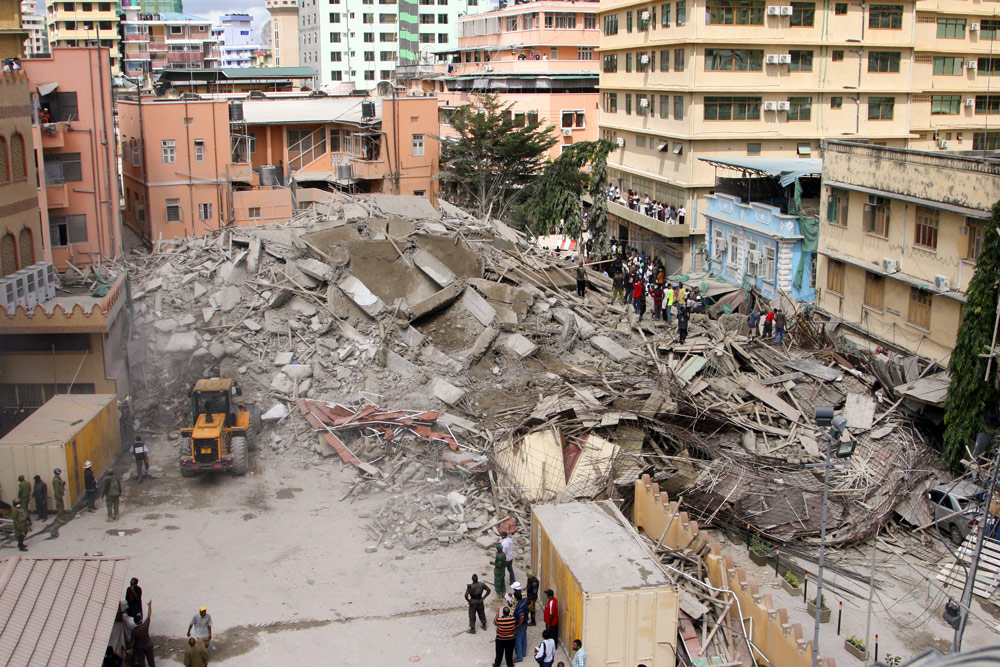
Governments were unsure how to react. If they banned cemsure the construction industry would collapse. It would take years to rebuild the portland cement industry and alternative construction materials would require redesign of all structures. The Pension funds had invested billions of dollars in infrastructure and buildings. They would be wiped out without government assistance.
Cemsure Corporation was owned by Pension funds, mainly in Canada. They were concerned that a ban on the product would wipe out their investment and open them to worldwide claims for damages as structures began to fail.
A technical committee was established by the US Federal government to establish the extent and
rate of deterioration in structures that had used cemsure. It would take 12 months for their work to determine government policy on future remediation. Politicians couldn’t wait that long as the potential to have collapses and deaths was too high.
The media began to publish nightmarish scenarios of collapsed buildings with hundreds of casualties and deaths. Calls for action against the owners of Cemsure put the government in a difficult position. The pension funds were clearly not to blame. They had been advised by Darling Corporation who claimed their due dilligence had been thorough and that the origional owners must have concealed key information.
Over the next 12 months hundreds of structures were condemed and homeless people were protesting that the government had approved the product and should pay compensation.
Cities were gridlocked as bridge closures blocked main arteries and reconstruction was impossible due to the lack of portland cement.
Figures started to emerge on national unemployment and homelessness. Reconstruction costs were in the trillions of dollars. Politicians demanded answers and more enquiries were set up to cope with the growing community unrest.
The environmental activitists were strangely silent. They had pushed hard to promote Cemsure and had never questioned its reliability.
Eric watched all these events unfold with amazement. Harry had called him several times but he could offer little help. He was a chemist and not involved in the construction industry. He had made a discovery and the world had embraced it.
John and Dave had caught up in Nice in the south of France after a few years of travel.
They were having dinner with their wives Janis and Alice in a restaurant overlooking a calm mediteranian sea. Janis started the conversation “ Every paper I read talks about the Global Cement Crisis (GCC). Weren’t you involved in cement John? “ Dave glanced at John with a quizical look. “Janis it was a long time ago. Dave and I worked together to improve the construction industry with a new product. We sold the company to some financial guys who were wizz kids with money. It’s all in the past.”
Alice explained to Janis that they had been sailing the world for years in their 68 foot ketch and had lost touch with the mainstream. She went into detail about the boat amenities and John refreshed their glasses with a very good red wine from the Rhone Valley.
The waiter approached the table with a phone. “ Is there someone here called John? “
“ Yes” John took the phone and discovered Eric was on the line from Australia.
“ John, Ive had my team study the instability problem with cemsure. I think we have come up with a fix! There could be some money in it.”
Grahame Campbell
BANGLADESH LNG
Early in the new decade of the ’80s when oil and gas was was at its peak of development Steve Harrison called from Houston and asked if I could go to London to meet a Huffco development manager to discuss a new potential project in Bangladesh. I was currently country manager in Trinidad. Steve was aware that the LNG plant that I was trying to advance at Pt Lisas on the western coast of Trinidad had been stalled as the US government was changing the rules regarding the pricing of imported natural gas.
On arrival in London I needed a visa for Bangladesh, so I went to the High Commission, which happened to be a terrace in Knightsbridge. As I walked in I saw bullet holes in the wall of the terrace next door. It was the Iraq Embassy, where they had had a shoot-out the previous week. I had been trying to develop a gas project in north eastern Iraq a few years earlier but it had been scuttled by a war between the government and Kurdish nationals where the project was located.
In the basement, through a small window against a wooden blank wall the clerk told me that my visa would take a week and I needed seven copies of the application and seven photographs. I said, ‘Look, I don’t want to go to Bangladesh, but my boss and your boss, the President would like me to go, so I’ll be back tomorrow. You do have two copies. It’s your choice.’ He looked at me blankly and I left.
In the morning around 11am, having collected my passport and visa with no fuss, I went to see the commercial attaché upstairs to get details of the area in the south of Bangladesh where theproposed LNG plant was to be sited. I was told that the attaché didn’t turn up till noon and then only stayed 30 minutes before going to lunch. I asked if I could wait in his office. This didn’t seem to be a problem even though there was no secretary. I looked around the office and noticed piles of reports on several tables. I found pretty much everything I wanted, so I bundled up the documents and left, telling the receptionist not to worry. As I went down the stairs and out, I noticed a Rolls-Royce pulling in with several Bangladeshi officials; I assumed he was one of them. I walked right past them and went on my way. I met with the Huffco representative and ran through the proposed development. I showed him the documents I had obtained from the High Commission and we spent a couple of hours sketching out the fundamentals for a new LNG plant. We agreed on a plan and I headed for the airport feeling well prepared.
Once in Dhaka and settled into the hotel I needed to meet our local agent, Ahmed Rahman. I had to wait a couple of days for two Huffco engineers from Houston, Bob Drake and Alan Gale, who were coming to give me a hand, The hotel was quite grand and seemed to have diplomats as their main guests. The garden and pool area was very nice but had many large blackbirds walking on the grass who seemed very aggressive.
Many years before, Shell Oil had discovered a large gas field in Bakhrabad, in the north-east of the country. Shell was not interested in gas and had abandoned the discovery. The emergence of LNG had stimulated the government to explore options for development of the gas. Roy Huffington had met the national president at a conference in Europe. Roy explained that LNG would provide a good export industry for the country as their main export was sisal for bags which was a low margin product. Roy’s company Huffco had built the world’s largest LNG facility in Kalimantan Indonesia a few years earlier in record time. Our visit was a follow-up to assess the viability for export of the Bangladeshi gas abandoned by Shell. The main difficulty lay in finding a suitable port as the offshore water depth was too shallow for large tankers. Chittagong in the south was the main port but it was too shallow for our needs and a location further south at Cox’s Bazar was suggested.
Dhaka is a miserable place. We were there in the monsoon season. The people are downcast and poorly dressed. Litter in the gutters chokes the drains. Everything seemed damaged, with footpaths broken and street signs twisted. Ahmed owned a steel fabrication plant on the edge of town that produced steel reinforcement for concrete and insisted I visit his facility. He wanted to demonstrate to me that that he was an industrialist of note and an important man in the community. Hundreds of people were outside the perimeter fence, waiting for a job. This surprised me, because it was the most dangerous plant I’d seen. As we walked around I noticed that the equipment was old and safety screens were minimal. ‘Do you have accidents?’ ‘Yes, unfortunately,’ Ahmed replied, ‘but there are many people who will fill the places of the injured.’ I couldn’t get out of there quickly enough and took an instant dislike to Ahmed.
However, the port was picturesque and I took pictures of the colourful sail boats. I saw a cement barge being unloaded and again realised safety was of little concern. A line of fifty men carried a bag each to be filled in the hold and then trudged to the waiting trucks, where they emptied their bags and repeated the task. Each time they passed through the hold they inhaled cement dust. They would all be dead in a couple of years from silicosis. I wondered how we could build a modern sophisticated operation and run it when these activities were tolerated.

We had planned a visit to the fishing port of Cox’s Bazar, which was close to the proposed site for the LNG plant and terminal. It needed to be that far south to allow an LNG tanker to dock in the shallow waters of the Bangladeshi coast. IMEG, a British consultancy, had performed a preliminary study suggesting a plant could be located behind a large inlet to the north of the town. At dinner, we met our pilot, Hasan, who was the chief flight instructor for the country – a good sign. I explained to him that we needed to overfly the area around Cox’s Bazar to see the pipeline approach landscape, the plant site and the marine environment. I said we would take photos along all the runs. He agreed quickly, but seemed more interested in the whiskey we provided. He paid little attention to our discussions and finally collapsed in a drunken stupor – not a good sign.
The team arrived and with our agent took a local flight to Chittagong and boarded an old Wiley’s jeep for the journey south. It was very uncomfortable as Ahmed and the driver sat on the front seat and the three of us were on seats facing each other in a separate cabin behind. It was difficult to sit up straight and we bounced as the back wheels hit ruts. On arrival into Cox’s Bazar we were greeted by ram shackle buildings spread along a wide long beach. After checking into the local hotel we immediately went to the local airstrip to find our pilot. Hasan was very jolly and seemed to have recovered from his hangover. We boarded a small four-passenger Cessna. Bob and I got in the back so Alan could take photos from the front seat. There was a man lying on the floor under my feet. I said to Hasan, ‘What’s this?’ ‘Oh, he’s a trainee pilot just getting up his flying hours. Is he in the way?’ ‘Yes, don’t be crazy.’ The man crawled out of the plane. Hasan started the engine and we were taxiing in seconds. He didn’t seem to check any of the instruments, I was very concerned as pre flight checks were a major part of safety procedure. We passed a burnt- out small plane, which Hasan acknowledged was the result of pilot error, and we readied for take off. As we cleared the perimeter fence, Alan took out his camera to be ready for his shots. Hassan turned and said there could be no photos; we had no permission. Hasan and Alan argued and I told Alan to put the camera away till we reached a few thousand feet, as Hasan seemed to be more interested in arguing than flying the plane. At altitude, Hasan and I discussed the plan. He said we were too close to the Burmese border to take photos and anyway we did not have a permit. I said, ‘Why don’t you fly the plane where we tell you and don’t look at the camera. Pretend it doesn’t exist.’ He finally agreed and we continued. After half a dozen runs we made it safely back, but I could have killed Hasan. Safety protocols seemed to be a luxury in Bangladesh.
The next day we went across to the proposed LNG plant site in our jeep and met the local villagers. The head man greeted us with reverence and we were invited into the community hall. A welcome ceremony had been arranged with dancing and singing.
This was followed by a feast of the local fare of offal and rice – quite an ordeal. With the formalities completed the chief led us through paddy fields to the inlet river bank. At one point he stopped and put his finger to his lips, I nearly tripped over him, and then pointed just in front. A large krait snake was sliding from one pond to the next; it seemed to be about 2 metres long with blue and yellow bands. I was glad I was wearing cowboy boots as the snake was the deadliest in Asia.
After viewing the proposed LNG site we hired a tinnie to travel the river which exited the south end of the peninsular to the west to get soundings for the tanker channel. As we made our way downstream and out to sea I noticed a strong current taking us out. I saw the sand bar in the distance, with large waves. It reminded me of my horror when the three children died at Brunswick heads all those years ago when I was a child. I asked the boatman to start the engine and held my breath. It fired up and we started back against the current. When we were nearing the jetty I asked the boatman how much fuel he had left, as it had been a slow return. ‘Almost out, but we here.’ This rammed home to me that I had put my team at risk: if the motor had failed or the fuel had run out we might have drowned, as the current would have dragged us to the raging offshore bombora.
The hotel was half built, as were most of the dwellings in the town. Cox’s Bazar is touted as the Riviera of Bangladesh. ‘See Cox’s Bazar before the tourists discover it!’ spruiked the ads. A mini boom had triggered a building spree, but it had fizzled out. No one came. It was mosquito-infested, but the 145km beach to the south was a highlight. Millions of small red crabs moved like awave as you drove along the beach – extraordinary! It was the highlight of my entire stay in the country.
Ahmed took us our for dinner at a restaurant where he had assembled some local dignatries to introduce our mission. I was surprised that most spoke english and were interested in our work. I made an overview speech to give them a feel for the scope of the project. It would involve the expenditure of many billions of $US over several years. There would be significant disruption of the infrastructure and thousands of foreign workers would be moving in to camps to facilitate the construction. I emphasied that local labour would be offered as much work as their skills could cope. Their were no questions and I asked Ahmed for his reaction to my speech. He was most concerned. He said I should not tell to locals so much as they may misinterpret my comments. He said the national government would set the rules and everyone would have to obey. I realised that we needed to understand how the government and the various beauracracies operated as my experience to date was fairly negative.
I asked the team after the dinner back in the hotel for their impressions and were there any issues that we had missed. They were happy with the technical issues so we went to bed.

On our drive back to Chittagong in the jeep we continually stopped to fill the radiator with water. We had two swampers (labourers) just for that. We entered a forest just south of Chittagong and on rounding a bend were confronted by a stone wall across the road. The driver slowed and Ahmed started screaming at him to accelerate. We crashed through the wall and people ran out of the forest towards us, waving rifles and firing shots. As we hunched over in the back of the jeep thoughts flashed through my mind. We have no weapons, do we fight? I had no idea. We accelerated more and rounded another bend till we were out of sight. I yelled at Ahmed ‘ What was that!?’ No answer. ‘Are we still in danger?’ Ahmed finally said ‘ Hill tribesmen’. It meant nothing to me. We were unaware of the local uprising of the Shanti Bahini of the Chittagong hill tribes, and would have had no way of defending ourselves. We stopped at an army outpost about 8km further along and Ahmed jumped out to talk to the officer. The soldiers immediately sent a truck south to investigate the stone road block as we resumed our journey north. Nothing more was said.
Back in Dhaka, we were scheduled to meet the head of the Petroleum Ministry to update him on our work. It was raining and we entered a building whose windows hadn’t been cleaned in decades. The large spiral stairway inside the entrance concealed beggars who stretched their hands toward us as we passed. The clerk greeted us and we were seated in a large, dingy room looking over the street, which was all but invisible through the filthy windows. Our host Zahir Patoyari arrived and invited us to order tea or coffee with his aide. Zahir was nattily dressed in a pin-striped suit with highly-polished shoes. As we sat down the power went off and it became gloomier. Zahir ignored this and we discussed the LNG project. He enquired about our findings in the south and I said the lack of infrastructure was the main issue. Cox’s Bazar is a fishing village and there is no industrial support. Everything would need to be imported. He stared at me impassively. I continued, the various bureaucracies might prove hurdles for development as here seemed to be rules for everything. He said the President would ensure we had all the cooperation required. This was a national project and he asked me to be optimistic He asked his aide to provide copies of government initiatives that would help our understanding. We chatted for half an hour, but no tea arrived and neither did the documents. The power was still off. We rose to leave and Zahir assured us that the documents would be sent to our hotel when they could be printed. As we made our way down the giant staircase the beggars outstretched arms reminded me of the environment. Why were they allowed in the building?
We were back on the street and the rain teemed down. For the locals, being poor was bad enough, but huddling under a piece of plastic to stay dry must have made their poverty immeasurably worse.
The team assembled in the hotel to review our findings. The overriding issue was the lack of access at Cox’s Bazar for LNG tankers. The IMEG report glossed over this with a statement that a channel could be cut through the offshore bar and maintained. But we had experienced the volume of water that moved with the tides. An access channel was impossible to maintain, and my coastal engineering training reinforced this. Mounting a large project in this environment was fraught with difficulty; also, the bureaucracy would drown you in paper. My instincts told me to report negatively back to Houston.
I wrote my report with the main focus on the ship channel. I believed the IMEG report was incompetent as they had no knowledge of the coastal environment.
Fourty years later I reflected on the project. It was never built and the gas was eventually used domestically for power generation. However a nuclear power station was built in Japan at Fukushima. The expert designers focused on the nuclear technologies and failed to recognise the potential for a tsunami wave. The plant was subsequentially destroyed by such a wave.
I also remembered that the LNG plant in Bontang Kalimantan was interupted by jellyfish clogging the inlet cooling water system. This had occured as a result of increased water temperature caused by the operations. These were multi billion dollar developments that were not properly evaluated in the broader marine environment.
Engineers need to step back and think about the bigger picture when designing these major projects.
STARTING A NEW JOB IN ENGINEERING
In 1968 CMPS, a consulting engineering company in Chatswood, was looking for a project controls engineer, which was a new area evolving with the development of computers. Chatswood was a good location, as I was living in not-too-far away Forestville. Kevin Torpey, a brash young manager, interviewed me. His speech was peppered with expletives. Computer skills were his main focus, and he was keen to use a new IBM product for project management. After an hour of grilling he offered me a job… if I was able to pass the scrutiny of the partner, Eric Mansfield.
A secretary led me in to a wood-panelled office where sat a gentleman in a pin-striped suit and striped shirt. Eric Mansfield was courteous and offered me tea. Then he began. ‘Well, where have you come from?’ ‘McDonald Constructions, sir.’ ‘No, what school?’ ‘Oh, Sydney High.’ ‘Hmmm, good rowers and quite good at football. Well done. What did you play?’ ‘Tennis, sir.’ ‘Excellent! That’s my game. I hope you’ll be happy here.’ I was surprised that he didn’t quiz me on my technical skills. I returned to Kevin’s office and he gave me the papers to join the company. ‘By the way,’ he said, ‘the job’s in Melbourne.’ This was a surprise, but I was happy. I explained that I was looking forward to working with the team in Sydney and Kevin added ‘It’s only for a year, they need help down there’.
I rushed home to tell Margaret the news. She was relieved as she was two months away from having our second child. I had mentioned that it was likely that we would be in Coonabarabran if I stayed in my current job. There was much to be done as I needed to rent our house in Forestville for the year we would be away. I also needed to give notice at McDonalds which was hard as they had been very supportive although there were no contracts that I could move onto, just prospective possibilities. Such was the life of a contractor.
We flew to Melbourne for our new adventure a few weeks later. I reported to the CMPS partners’ office on the top floor of Clunies Ross House in Parkville. I was ushered into a well-appointed corner office, to be confronted by a short man who introduced himself as ‘Nairn’. He stared at me coldly. ‘You’re the new man from Sydney?’ The emphasis was on ‘Sydney’, as if it was a dirty word. ‘Yes.’ ‘Why are you here?’ ‘They said you need a project controls engineer.’ ‘We don’t need one, they think we do. I was against it. Never had one before and Melbourne engineers can control their own projects.’ Nairn said forcefully. I paused for a moment and said, ‘I’m to introduce a new IBM management program that’s driven by computers.’ His eyes narrowed ‘Well, we don’t need American technology here. British technology is what we use.’ With that, he started reading his mail, ignoring me. I was getting a message: Sydney folk are not welcome.
Nairn’s secretary showed me to my desk and I introduced myself to some of the people around me. I then called Kevin Torpey at the Sydney office and told him about my exchange with Nairn. ‘Yes, he’s an arsehole. Only likes people from Melbourne and Adelaide. You’ll find the project manager’s a prick too.’ ‘Great,’ I said, ‘what have you got me into?’ ‘Look, don’t worry about that. Get the controls set up, liaise with the main contractors and find out where the project sits, cost and schedule wise.’ I took some comfort from Kevin’s words, but Nairn had shaken me up. I felt isolated. I had taken my family interstate, rented my house and changed jobs.
I was still idealistic about my profession. I hadn’t realised that personalities would play such a strong role in the engineering process.
Electrolytic Zinc and Goldfields had joined forces to deliver a total change to the west coast mining operations in Tasmania. Copper, lead and zinc were currently being exported via an APT railway from Queenstown to Strahan, and then shipped through Macquarie Harbour. The bar in the harbour was quite shallow and difficult. The system was old and expensive to maintain. The turn-around involved shutting the copper smelter and exporting metal concentrates north via the Emu Bay railway to the port of Burnie. This required new rail-handling facilities at Melba Flat, Rosebery and Burnie with a rail upgrade, principally at the Pieman River, involving a new high-level bridge. Additionally, the iron pyrites (fool’s gold) would be transported and processed at a new sulphuric acid plant at Ulverstone, near Burnie. There were many elements that needed to be coordinated. Some of the sites were remote and the west coast suffered high rainfall.
I started to map out a program and found the other staff members enthralled by what I was doing. They had never seen the planning tools I was utilising, but were willing to give me the necessary data I needed. I visited the IBM offices and outlined my requirements. They were generally unhelpful, as they were largely salesmen who weren’t familiar with this product. The experts were in the United States. I liaised closely with Kevin Torpey in Sydney and we found more helpful and knowledgable IBM people there. Kevin arranged a meeting in Burnie in Tasmania – ‘in the pub by the jetty at 5’ – the following week to check the port and acid plant sites. He would be driving from Hobart, as he had meetings with the Electrolytic Zinc people. We had other projects in Risdon near Hobart.
I flew into Wynyard, a few kilometres west of Burnie, and took the shuttle bus to town. Armed with some plans from the office and wandering around the port I tried to visualise our facilities; I began to understand the scope of our project.
At five pm I headed for the pub and waited for Kevin, who burst into the bar at five thirty, cursing about several things that were annoying him. ‘Bloody hell! Simple things seem to trip up Nairn. He has no concept of a project. He’s only interested in the status issues, organising lunch and brown-nosing the Goldfield executives. You OK?’ ‘Yes.’ I replied open mouthed. Kevin dug into his bag looking for memos. He paused, looked up and asked, ‘How’s Nairn treating you?’
‘Fine, he doesn’t talk to me.’
‘Good, he’s an arrogant prick. You need to get with the contractors and come down here for a week a month to keep up with the local gossip. Reading reports is no good – they only want to tell you the good stuff.’ He wrote some more notes and I got some beers. We went through all the issues with the rail upgrade, as it seemed the most vulnerable to government interference and delays. More beers and discussion saw the sun disappear and Kevin exclaim, ‘I’m hungry! By the way, where are we staying tonight?’ I looked at him blankly, and said, ‘Your girl made the booking. I’ve never been here before. How many hotels are there?’ ‘Buggered if I know. We’ll just have to ask around.’ We drove off in his car as the pub where we were drinking had no reservation and was full. By now it was eight thirty and every hotel or guest house we found was closed.
‘Christ, I have to eat. There was a fried chicken place on the main road next to a service station.’ Kevin exclaimed. We went there and tore a fried chicken apart with our bare hands. The chicken was delicious and we felt better.
It was getting cold and the warming glow of the Boag’s beer was wearing off. I asked the attendant at the service station about hotels. ‘There’s one on the hill you might have missed, up by the carpentry workshop.’
We drove up, but it looked closed. Kevin said, ‘Don’t worry, we’ll go around the back.’ We did so and entered through the kitchen and found the manager. ‘You’re a bit late! Come into the office.’ It was the right place. We put our bags in a share room and Kevin started for the bar. ‘They have early closing, but we’ll be right.’ We entered the bar to lots of noise and almost a full house.
‘It’s my shout. Find a seat.’ There were none, but a large timber worker created a space at the bar. ‘What are you doing here?’ he asked. I explained a bit and he nodded. ‘Great to see the place booming. Good luck!’
Kevin returned with a couple of pints. ‘Who was that?’ ‘No idea, but he was onside.’ ‘You’ve got to be careful, there are people against the project.’I left Kevin at ten thirty. He was involved in a vigorous conversation about Irish politics. I was tired and a bit drunk and fell into bed. I walked into breakfast at six thirty next morning to find Kevin halfway through his eggs. ‘I didn’t want to wake you and I need to get back to Melbourne. I’ll leave you the car if you drop me off at the airport.’ He looked chipper and I felt hungover. ‘Don’t let Nairn get you down, we can work through this’ were his final words at the airport.
The project was coming together and the family had settled into a maisonette in South Yarra. Margaret was due in a few days and David, our 2 year old son, was running riot. We had an unexpected visit from my best mate from Sydney, Robert Edwardes. He was passing through Melbourne at the start of his trip. He and his wife Carolyn were off to Europe on a world trip for a year. They were both school teachers but had taken leave for the trip. He quizzed me on the project, while I kept an eye on my wife in case we had to dash to the hospital. He asked, ‘Are you spending much time in Tassie?’ ‘About a week a month. I’m still trying to find out how the company operates. The Melbourne people don’t get on with the Sydney head office. It’s hard when you’re new and you don’t feel welcome. My boss in Sydney is supportive and I think things will work out.’ I wished I could emulate Robert and do the Aussie thing and do Europe, but I had a growing family and work was my priority.
My efforts to introduce structure into the project were frustrated by Nairn and his project manager, Jim Smythe, who came out of the same mould as his boss. I persevered and wrote the monthly report based on my financial and schedule reports.
I adopted the construction daily schedule of starting fairly early in the office around 7am. Other staff usually came in around 8.15am. I found the quiet atmosphere good for thinking out the day’s activities. I was unaware that Nairn liked to be in first as everyone had to pass his office. One morning as I came past his office he was standing there waving a report. ‘ I don’t want you sending me these reports, I’m not interested.’ He ritually tore it up and threw it in the rubbish tin as he retired to his office. I sat at my desk and wondered what to do. I decided to continue with the reports and just put them in the files.
The following month in my report I criticised the acid plant designer and builder for suppling optimistic schedules and not recognising supply chain constraints. I was called into a meeting Nairn was having with the contractor. ‘Grahame thinks you don’t know what you’re doing. How many have you built?’ snarled Nairn. ‘Sixty-two,’ was the contractor’s reply. Nairn looked at me, ‘How many have you built, Grahame?’ It was an ambush. I ignored his question and asked how long they had been using their project control tools. ‘This is the first time.’ Touche! ‘Right. The option you used to predict the end date assumed all activities would occur with no delays, and no risk assessment was applied?’ Yes, that’s right.’ ‘Well, where are all of the bin liners?’ (This was a new high-tech plastic material to protect the steel.) He checked his printout and announced, ‘They’re in the store in Burnie. They arrived three days ago.’
I said ‘I’ve received a report from a mate on-site that the bin liners had suffered an accident during offloading and were actually in the harbour. ‘We have no report of that.’ ‘Well, you might want to make a phone call.’ I looked at Nairn. He walked out of the meeting.
The contractor and I spent several hours going through the detail and agreed there was a likelihood of a delay, but judicious overtime could haul that in. They left, cordially suggesting we might have a drink later in town. I agreed, although I needed to check Margaret’s condition as she was nearly due. I found that by gaining the contractor’s confidence and sharing information you could break down the barriers set up by the contract.
Next morning Nairn confronted me. ‘You don’t want to compromise yourself with contractors. We could end up in court and they could use certain information against you.’ I replied, ‘If we document all discussions and agreements we should be safe, and the contractor will trust you more.’ ‘You can never trust contractors. They’re just after money and don’t have the professional ethics that we have. Be careful’. I went to my desk and pondered this. This elitist attitude was strange to me. I hadn’t detected any higher level of intellectual insight to support his position. The contractors employed many fine engineers; in fact, I had recently been employed by one myself. Nairn had never bothered to find this out. I vowed to go with my gut feel and work closely with them.
I needed to find a topic for my master’s thesis. After much deliberation I decided to look at the relationships between design and construction activities. All efforts in scheduling had focused on the logic of the construction task and the resource levelling benefits that this planning tool could bring. I would focus on the complete project task, from conception to completion. My first hurdle was convincing the university and finding a thesis supervisor who would take it on. During my visits to Sydney to brief Kevin and his boss Kevin Napier, I talked to the civil engineering school where I met with a cool reception. They weren’t really into the management of engineering, just the engineering itself; they were unaware there were problems there to solve and wondered if my project had any merit. Finally, they suggested I talk to Michael Folie, who had just joined the faculty from the economics school. Michael listened to my ideas and suggested I develop them along the lines of resultant economic benefit, that is, the faster project delivery lowers the cost as production can be sold earlier.
I returned to Melbourne and started gathering data. I needed to spend time with the designers to understand their processes and how the interdisciplinary design needs were handled. I was met with quizzical looks. ‘Why do you need to know? It’s very complicated, we just work together.’
I started to spend time with the lead designers, asking how they confronted their job. They obviously knew what they were doing, but they’d never had to visualise the process in a forward-planning way. I started to piece together elements of a process and fed it back to the leads. Though sceptical, they played the game. After a while there was some good banter, with an overtone that my task was a waste of time. ‘Design is an art and can’t be systematised,’ seemed to be their anthem. They felt I was commoditising their profession and that that could diminish their value. As the project developed I collected data and tried to reconstruct events into logical sequences. I also tried to monitor the crises when packages of drawings and documents needed to be issued for contract bids. I noted that deadlines were achieved by having holds on areas when design was incomplete, either for lack of vendor data or because of client changes. Contractors were asked to price work that was not defined. This led to difficult evaluation processes and unit price quotes. As the many parts of the project started to converge, the planning and costing work that was my main task became more difficult. I was starting to feel inadequate.
The chief estimator was Bob Williams, from Sydney. He was experienced and helped me understand how the particular processes worked. Unfortunately, he too had a bad relationship with Nairn, whom he considered a complete idiot. ‘If Nairn could manage the client better and stop snivelling up to them we could reduce the changes. How can you design something when it keeps changing? You have to fix the process flow diagrams and then the plot plan, otherwise you keep chasing your tail and costs escalate and the schedule is blown.’
Instantly I started to see why I was making no progress. There was no leadership. Nairn never consulted the schedules and trending was a totally foreign concept to him. He started each day as a new challenge, with no reflection on where our plan stood. I felt my best efforts would come from continually talking to the leads and trying to piece together a story.
Meanwhile Margaret was due. All babies seem to be born in the early hours of the morning and so it was with my second son, Miles. Margaret and I arrived at the hospital at eleven thirty pm. Miles was born at two am. We were very happy.
Back at work the project lurched into the mid stages. Nairn came under pressure from the client and became agitated. We were not meeting the target dates due to the numerous changes. He started attacking all the lead engineers, with no real purpose other than to suggest it was entirely their fault. I found his negative attitude to me began to change as he realised my work could help the team get on top of things. They started asking questions about planning and I tried to organise coordination meetings to share information. I realised that some of them were doing the biggest job of their careers and we were all as inexperienced as each other.
I was regularly visiting Tasmania and with the persistent rainfall, the work progress in Rosebery was slow. We had hired a local earthworks contractor named Bill Singline to clear the rail handling site. Bill was a personality in Tasmania. He had a logging business, a supermarket and a fledgling mining company, Tasminex, trying to export iron ore from a mine south of Burnie. His earthworks operators had come to a grinding halt on the site. Bill was totally bogged down, with a pile of cut material that was unsuitable for fill as it was spoiled with water penetration. He had submitted a claim for extra costs that exceeded his total contract value. My job was to find a way to get the site back on track. My background in soil mechanics gave me a good understanding of the problem. The spoiled material could not compact due to high clay content. We needed to locate a source of sand and loam to create the fill.
I met Singline’s foreman and ran him through my ideas. Had he considered mine waste? ‘Grahame, I just manage the plant. You have to give me a lead on what material will work. Bill will just walk away if you don’t give us some money. We’re in your hands.’ This was a surprise. I thought Bill was a successful businessman. Said his foreman, ‘He’s all front, runs things by the seat of his pants.’
Next day I visited the mine. The mine manager Ed Jones was very helpful and suggested a few possibilities. He was aware that the project was important for him and went out of his way to have some material tested for its suitability as fill. Over the next few days Bill’s man and I agreed on a rough compensation plan for the new fill material. We had a solution.
Back in Melbourne, I was bogged down. I reviewed my thesis data. I had been collecting statistics on drawing numbers, material take-offs and costs. The design functions and their interrelationships were still muddy. I didn’t have any benchmarks and the design leads just seemed to respond to crises. I started a new round of questions along the lines of what would they have done better now they could see the recent history. Anticipating the external needs was not easy. The mechanical guys relied on vendor data for the conveyors, bins, chutes and crushers. There didn’t seem to be a good system of anticipating the inputs and then refining the design when final data was received. The purchasing group was isolated from the processes because the designers didn’t see the value of their input. Contract documentation was not managed well, adding to the confusion.
How could all this be improved? The main problem was that the engineers were focused on their design competency and took no responsibility for the project needs. This gap was the responsibility of the project engineers. However, their role was diminished by Nairn and his project manager Smythe, who bypassed them. I reported all this to my bosses in Sydney. Finally, Nairn was instructed by Sydney to hire a new project manager, Norm Elphinstone. I felt elated but worried as to how the transition would play out.
Nairn treated Norm as he treated me, but Norm was more senior and seemed to handle Nairn well. This improved the office performance, and Norm encouraged me to spend more time with the project engineers, to improve their planning skills. He also gave me more insight into the design interfaces and the potential for different contracting strategies. I started to see ways to package work to improve the overall schedule. I felt I was making real progress.
With Norm on board and some new project engineers hired, the project started to have some structure. I found the new team fun to work with. Nairn was now nice to me. ‘I was reading your monthly report,’ he said. ‘I like the trending section; it gives us a good idea of status. The client likes it too. Join us for a drink this evening.’ After nine months on the outer, finally I was in the ‘in group’!
I had learned so much in Melbourne, but little of it related to engineering, or my idea of what an engineer is trained to do. After leaving NSW Railways I had been exposed to the realities of commercial life in a contractor’s office. It was a shock, but helped me understand the nature of construction. The railways had no cost constraints and there I had been able to experiment without fear of failure. My experience in Melbourne had revealed a different environment. The different cultures represented by government, project owners, contractors and consulting engineering came together with very rough edges. Each had a different view but all played their role in the development world. Lack of understanding among the groups gave me many hours of reflection and a great source of inspiration for my master’s thesis.
One year on and exactly to the day I left Melbourne to return to Sydney for new adventures. Nairn encouraged me to stay with a pay rise and new responsibility. I politely declined and left.
Ten years later I returned to Melbourne to take Nairn’s job and run the Southern operations, but that’s another story.
Grahame Campbell
MAKE EVERY DROP COUNT
I have prepared a paper on the state of our monitoring of groundwater in Australia.
I believe we should appoint a high level select group to oversee a resurgence in our management of this valuable resource. With an initial budget of $100 million and the allocation of $1 billion over the next 5- 10 years we could secure a world class system to manage our most important asset.
This would complement the data gathering and integration system developed and managed by the BoM. That $500 million investment would be enhanced by quatity data.
This investment would be important to our understanding of climate change as we monitor the movement and quality of water hidden in our aquifers and artesian basins. There is a strong connection between our water and the environment created by our climate.
Community interaction would create a sense of pride that we, as Australians, are serious about looking after the place where we live.
The world will come to see that Australians care about the environment and are willing to commit to world class management.

Aquifer groundwater is a crucial and valuable resource for Australia, but is poorly managed and monitored to the point of being neglected in some areas. This neglect is a risk for the future of Australia’s $60 billion agriculture production and industry that relies on the resource in an arid country.
About 30% of Australia’s total water consumption comes from groundwater, and use of the resource is increasing (estimated to have increased at least 90% — nearly doubled — in the 15 years from 1985-2000 alone).
About 70% of the groundwater extracted is used for agriculture, and accounts for about 30% of the overall water used for agriculture. There is also strong reliance on groundwater for household water and other uses, with the Northern Territory in particular relying on groundwater for 90% of its overall water requirements.

The volumes of water drawn far outstrip the estimated restocking from natural recharge, resulting in groundwater levels falling in many parts of Australia.
However, it is impossible to accurately gauge how much the levels of groundwater resources have fallen, due to the poor monitoring of groundwater extraction, lack of proper management, underpricing of the resource, and lack of acknowledgement of its importance.
A renewed effort to audit and evaluate the current state of the monitoring system with recommendations for improvements to bring it up to an acceptable level is needed.
Contents
Executive summary ………………………………………………………………………………………………………………… 1
Current Status of Groundwater Use and Management……………………………………………………… 2
Groundwater extraction ……………………………………………………………………………………………………. 2
Groundwater monitoring system and technology …………………………………………………………………… 3
Groundwater management and stakeholder involvement………………………………………………………… 3
Case studies …………………………………………………………………………………………………………………………. 4
Namoi Catchment …………………………………………………………………………………………………………… 4
Surat Basin …………………………………………………………………………………………………………………… 4
Conclusion and proposals ……………………………………………………………………………………………………… 5
Endnotes …………………………………………………………………………………………………………………………….. 6
Executive summary
Aquifer groundwater is a crucial and valuable resource for Australia, but is poorly managed and monitored
to the point of being neglected in some areas. This neglect is a risk for the future of Australia’s $60 billion agriculture production and industry that relies on the resource in an arid country.
About 30% of Australia’s total water consumption comes from groundwater, and use of the resource is increasing (estimated to have increased at least 90% — nearly doubled — in the 15 years from 1985-2000 alone).1
About 70% of the groundwater extracted is used
for agriculture, and accounts for about 30% of the overall water used for agriculture. There is also strong reliance on groundwater for household water and other uses, with the Northern Territory in particular relying on groundwater for 90% of its overall water requirements.2
The volumes of water drawn far outstrip the estimated restocking from natural recharge, resulting in groundwater levels falling in many parts of Australia; particularly in the Great Artesian Basin (GAB), which holds water estimated to be up to 2 million years old, and underlies 22% of the Australian continent — extending into Queensland, New South Wales, the Northern Territory, and South Australia.3
However, it is impossible to accurately gauge how much the levels of the GAB and other groundwater resources have fallen, due to the poor monitoring of groundwater extraction, lack of proper management, underpricing of the resource, and lack of acknowledgement of its importance.
There have been significant efforts over the past 30 years to manage this resource but the focus has waxed and waned. There is no continuous national work program to bring the system up to an acceptable standard.
This has come about because it is largely a State responsibility and States have not appropriately funded or maintained the management systems (largely monitoring bores and staff) to allow proper overview. The federal government has developed an integrated collection and reporting system (BoM) but this has faded in value due to the declining monitoring network which feeds it.
The Murray Darling Basin Authority has focused attention on some parts of the problem but its main job is to buy back environmental water via purchase plans and efficiency development.
A renewed effort to audit and evaluate the current state of the monitoring system with recommendations for improvements to bring it up to an acceptable level would be a first step.
The audit should focus on areas that would evaluate costs and benefits from both commercial and environmental viewpoints. We need to maximise the amount of water that can be safely made available to agriculture while improving our knowledge of the sustainability to safeguard future generations and also protect the ecological values and ecosystem service provided by the aquifers.
Current Status of Groundwater Use and Management
Between 2004 and 2006, the federal government and all state and territory governments signed
the National Water Initiative (NWI), reinvigorating coordinated national water reforms. Broadly, the
NWI sought to improve water governance, and the efficiency, productivity, and environmental sustainability of water use. Among other things, it focused on achieving transparent and statute-based water planning, nationally compatible water access entitlements, integrated management of surface water and groundwater, resolution of water over-allocation and over-use, effective water accounting, and open water markets. The National Water Commission was established in 2004 to oversee the reforms.
The 2007 Water Act gave regulatory teeth to elements of the NWI, at least in the Murray-Darling Basin. Contrary to common views, parts of the Water Act also apply outside the Murray-Darling Basin. The
Act grants substantial powers to the Bureau of Meteorology in relation to collecting and disseminating information about groundwater around the nation, much of which had been buried in paper files at state and local water agencies.
Though less sensational than reining in water use in the Murray-Darling Basin, the creation of an easily accessible repository of groundwater information provided vital support to agencies and businesses for understanding and managing groundwater resources. Unfortunately all of this activity faded away from 2013.
This is surprising given that children are taught from an early age that water is a precious commodity in the world’s driest continent.
Groundwater extraction
About 70% of the groundwater extracted is used for agriculture, and accounts for about 30% of the overall water used for agriculture. In 2018-19, 8 million megalitres of water overall was used in agricultural production, of which 2.3 million megalitres was groundwater (a rise of 6%).5 However, Harrington and Cook state there is wide belief that actual groundwater use may be up to double this.
There is also strong reliance on groundwater for household water and other uses, such as industry. The Northern Territory relies on groundwater for 90% of its overall water requirements, followed by Western Australia (around 63%), New South Wales (around 36%) and Queensland (32%).7
There is growing concern about the impact of falling groundwater levels resulting from increased extraction far outstripping recharging of aquifers — calling into question the sustainability of the resource particularly as the lack of monitoring has allowed over-allocation and underpriced or free extraction8
Groundwater overuse is a particularly thorny issue in the context of aquifers that were recharged during different geologic periods and climates, and are no longer actively recharged — for example, the Great Artesian Basin and the Murray Group Limestone aquifer that straddles the Victoria-South Australia border. In such areas, groundwater extraction permanently depletes, or ‘mines’ the resource. This ‘fossil’ groundwater supports around $25 billion (one- third) of Australian mineral exports, as well as many homesteads, towns, mines, and pastoral enterprises in this arid zone.
The key management issue is setting an acceptable rate of aquifer depletion, which involves considering the appropriate planning horizon, the direct and indirect costs and benefits of depletion to present and future generations, strategies for coping with post-depletion water scarcity, the protection of any ecosystems and cultural values that depend on the resource, public participation requirements, and appropriate monitoring strategies.
Groundwater monitoring system and technology
Australia’s network of 23,000 monitoring bores is key to the information needed for current and future management of groundwater. However, the ageing network requires a thorough assessment to identify monitoring failures and gaps.9 With better data we can develop better management.
As Rebecca Nelson noted:
In adopting a focus on controlling extraction, policy- makers have tended to overlook groundwater management approaches that rely on infrastructure or more active management. At least two notable opportunities arise in connection with a more active management approach: managed aquifer recharge (MAR) and conjunctive water management strategies.
Conjunctive water management strategically takes advantage of the different attributes of groundwater and surface water. For example, accessing and alternating between surface water and groundwater can increase water security and business flexibility, and engineering technologies can use aquifer storage space to maintain or enhance in-stream flows.10
There is general consensus that groundwater monitoring needs a significant audit and considerable support to bring it up to a competent management tool for good governance. It’s not clear that new thinking on the ability to evaluate the current available data is driven by necessity or the belief that acceptable results can be produced by innovation.
There has also been government reluctance or resistance to taking on board the local knowledge of water users in several important aquifer areas, such as the Namoi.
However, the Surat Basin seems to be the most comprehensive analysis of groundwater management in Australia, with extensive monitoring and modelling of extraction and recharge rates.11 Work done in
the Surat basin over the past decade could provide
a template for an audit to be conducted throughout Australia’s groundwater resources.
An assessment of groundwater monitoring technology by Sinclair Knight Merz (SKM) judged monitoring bores to be the “most reliable and low maintenance way to monitor resource condition in terms of cost, longevity, repeatability, and the ability to be implemented by jurisdictional or regional stakeholders—86% of monitoring data is collected through manual monitoring.”12
While remote sensing has been suggested as a solution for aquifers with a high distribution of extraction points, metered points remain the most accurate method for gauging groundwater use.
Remote technology has been implemented on only a small percentage of the monitoring bores, with dataloggers on 9% and telemetry on 5%, however this allows more frequent monitoring without the need to continually visit distant locations in widely- dispersed rural areas.
The reducing number, and growing deterioration, of monitoring bores was highlighted in a report by GHD on groundwater management in the Murray-Darling Basin, which found there was “increasing focus by states to rationalise monitoring networks for economic reasons” which undermined the ability to identify problems as they emerged. The report urged “regular revision of management plans, monitoring networks and underlying numerical models based on updated monitoring data,” citing scarcity and maintenance of the monitoring network bores as key issues.13
SKM further estimated in 2011 that an additional $52 million annually was required to repair and replace failing monitoring bores and conduct appropriate monitoring and maintenance — a 33% increase of federal funding — of which $36 million annually would be needed for planning and management that includes identifying groundwater planning as a separate component of overall water planning for “effective cost recovery.” However, a more considerable investment of $872 million would be needed if deterioration reached a stage where complete replacement was needed.14
Groundwater management and stakeholder involvement
Appropriate and effective management of both the groundwater and the monitoring networks can only be implemented when there is clarity about the objectives and responsibilities for all parties, including government departments, farmers and industries. The capture and inclusion of local knowledge would also reduce the risks inherent in relying on the currently-
Case studies
Case studies below will examine contrasts in management between the Great Artesian Basin’s sub- areas of the Namoi catchment and Surat basin.
Namoi Catchment
The Namoi catchment Water Sharing Plan (WSP) was completed after the overarching National Water Initiative (NWI) was finalised, and hence the NWI offered little information covering the connectivity between the groundwater system and the — usually dry — single riverbed above it, in a region where over-allocation of groundwater has become a serious problem.17
This problem is compounded by long periods of lag in obtaining sufficient data, with two decades of extraction in the Namoi Catchment before there was enough data to map the holdings and analyse the impact of extraction.
CSIRO noted that increased dedicated monitoring was needed “at a higher frequency along other reaches of the river network” as the reduced levels in the aquifer will result in “depletion of the river baseflow” itself, and that the past decade of groundwater extraction for irrigation has already caused depletion in the Namoi River.18
The results presented show that further research is required on the delivery and usage of water, at different times and to different locations, to achieve both goals of supporting irrigated agriculture and protecting groundwater-dependent ecosystems. This incomplete monitoring data as the basis of making decisions.15
Community and stakeholder engagement is crucial in the decision-making and management process, and should be integrated into considerations of the “wider context of surface water connections, catchment management and cross-sectoral issues with economics, energy, climate, agriculture and the environment.”
A disturbing trend in Australia is that we are losing our capability to study the problem as universities are cutting back on groundwater courses as funding dries up. R&D has been reduced and when we hit crisis levels in the future, which we most certainly will, we will have to engage overseas expertise which will take time to acclimatise to Australian conditions.
A little foresight could avoid the problem by setting up a key team to map out the work programmes to fill in the knowledge gaps. This can be more readily achieved if surface-water and groundwater are managed as a single resource at the catchment scale. We now have enough knowledge of the effects of groundwater withdrawals and their impacts on groundwater level, and on stream- and-aquifer interaction. This facilitates research opportunities on optimising the conjunctive use of surface-water and groundwater, while considering the ecological impacts.19
Surat Basin
The Surat Cumulative Management Area (CMA) contains around 22,500 bores. Around 8,100 draw from the Great Artesian Basin largely for stock and domestic (S&D), stock intensive, industrial and
town water supply. About 13,500 bores access the overlying alluvium (mainly the Condamine Alluvium) and tertiary basalts for irrigation and S&D purposes. The remaining 900 or so bores access the underlying Bowen Basin. The majority of groundwater extraction — other than that used in coal-seam gas production is not metered, leading to “a high degree of uncertainty in relation to actual use.”20
Ongoing research by the Office of Groundwater Impact Assessment (OGIA) and others, using scientific assessment and additional datasets acquired since the previous report three years earlier, was reported in 2019 to have improved understanding of the geology and groundwater flow systems in the Surat basin. It also allowed redevelopment of the geological model incorporating up-to-date mapping and coal seam gas(CSG) well and geophysical data in “a complex model that simulates 34 layers of geological strata over a large area – about 450 x 650 km.”21
The 2019 report noted that the monitoring network would be increased from the then approximately 600 monitoring points to 622 groundwater level and 103 water chemistry monitoring points — a 10% increase on the 2016 specification. There is also provision for ongoing replacement of monitoring bores that are no longer suitable.
This improvement in monitoring is used to more accurately calibrate the groundwater flow model, produce more accurate estimations of groundwater extraction and aquifer levels.
Conclusion and proposals
While the changes on the demand side can probably be predicted with reasonable certainty, the processes that govern groundwater recharge are highly non-linear in both time and space; and rely on rainfall amounts, distribution, intensity, frequency, temperature, evapotranspiration and soil moisture processes.
Because of the spatio-temporal variabilities and non- linear processes (small changes in climate variables may lead to large changes in recharge), we will likely be saddled with large uncertainties on recharge estimates.
A pragmatic solution to this problem is to determine the actual recharge by monitoring groundwater levels and to use the data for adaptive management. As we are recognising the role of groundwater for ecosystem services, groundwater-dependent ecosystems, and providing baseflow to streams, we should reconsider how we strategically locate our future groundwater monitoring networks to also monitor the health of ecosystems and impacts on ecosystem processes.
New or updated bore networks therefore need to be optimised to both monitor the state of the resource as well as impacts on ecological assets. Individual bores also need to be designed and optimised for both water level and water quality monitoring, whereas focus in the past has primarily been on water levels. To support this report research into a number of issues should be initiated
- Estimates of the spatial and temporal variability of groundwater recharge (the rate of recharge is the key sustainability parameter rather than aquifer volumes).
- Ecological impacts of groundwater drawdown and better methods for determining environmental water requirements and determining the true costs efficiency and effectiveness of reinjection schemesn the basin. The results suggest that groundwater declines are likely to be caused by non-CSG extraction from the Hutton Sandstone aquifer, and that reinjection is the leading positive effect on water levels.
The model is also the basis for predicting impacts from existing and planned CSG projects — both in
the short- and long-term (in which a water level decline of more than five metres is predicted) — which informs proactive ‘make good’ mitigation or reinjection arrangements. This saw 100 new bores added to the 122 previously identified with short-term impacts, with 88 assessed and 99 ‘make good’ reinjection arrangements reported as being implemented.22
- Water quality changes (deterioration) due to groundwater depletion as well as changes in physical water management (e.g. water quality changes caused by managed aquifer recharge schemes).
- Cost-benefit analysis of the true value of groundwater and processes it supports (including environmental, ecological social and cultural).
- Sociological studies of alternative governance and management strategies (e.g. cooperatives etc.).
Next steps
1. Develop scope of work for design of monitoring system described above including timing of work to review progressive updates.
2. Award contract
3. Review outcomes and develop construction plan.
4. Award sub contracts on an aquifer basis to install monitoring system.
5. Review effectiveness of work on a regular basis.
A higher level review of aquifer connectivity and its effects should be studied as data emerges from the work.
We spend billions of dollars on social programmes which will be wasted if we run out of potable water. Groundwater is a key part of the overall system and needs to be studied deeply to properly manage a sustainable future for our country.
Endnotes
- Groundwater Use. https://www.ga.gov.au/ scientific-topics/water/groundwater/basics/ groundwater-use
- 2 Harrington N and Cook P, 2014, Groundwater in Australia, National Centre for Groundwater Research and Training, Australia
- Jakeman A.J, Barreteau O, Hunt R.J, Rinaudo J-D, Ross A, Arshad M, and Hamilton S. Integrated Groundwater Management (IGM) An Overview of Concepts and Challenges 2018
- Groundwater Use. https://www.ga.gov.au/ scientific-topics/water/groundwater/basics/ groundwater-use
- Water Use on Australian Farms https://www.abs. gov.au/statistics/industry/agriculture/water-use- australian-farms/latest-release (May 2020)
- Harrington N and Cook P, 2014, Groundwater in Australia, National Centre for Groundwater Research and Training, Australia
- Ibid.
- Jakeman A.J, Barreteau O, Hunt R.J, Rinaudo J-D, Ross A, Arshad M, and Hamilton S. Integrated Groundwater Management (IGM) An Overview of Concepts and Challenges 2018
- Waterlines Report Series No 90, September 2012. Sinclair Knight Merz
- Nelson R. Groundwater Hidden promise, hidden perils – CEDA. https://www.yumpu.com/en/ document/view/37331996/groundwater-hidden- promise-hidden-perils-ceda. pp1, 12
- UWIR Surat basin 2019. Third Underground Water Impact Report
- Waterlines Report Series No 90, September 2012. Sinclair Knight Merz
- GHD, Hydrosimulations, Hamstead Consulting: Approaches to Achieve Sustainable Use and Management of Groundwater Resources in the Murray–Darling Basin Using Rules and Resource Condition Limits https://www.mdba.gov.au/ sites/default/files/pubs/Approaches-to-achieve- sustainable-groundwater-management.PDF
14 Waterlines Report Series No 90, September 2012. Sinclair Knight Merz
15 GHD, Hydrosimulations, Hamstead Consulting: Approaches to Achieve Sustainable Use and Management of Groundwater Resources in the Murray–Darling Basin Using Rules and Resource Condition Limits https://www.mdba.gov.au/ sites/default/files/pubs/Approaches-to-achieve- sustainable-groundwater-management.PDF
16 Jakeman A.J, Barreteau O, Hunt R.J, Rinaudo J-D, Ross A, Arshad M, and Hamilton S. Integrated Groundwater Management (IGM) An Overview of Concepts and Challenges 2018
17 G Kuehne, H Bjornlund: Frustration, Confusion and Uncertainty: Qualitative Responses from Namoi Valley Irrigators. 2006. https://www.researchgate. net/publication/228384776_Frustration_confusion_ and_uncertainty_qualitative_responses_from_ Namoi_Valley_irrigators’
18 Kelly B. F. J., Timms W. A. , Andersen M. S., McCallum A. M., Blakers R. S., Smith R., Rau G. C., Badenhop A., Ludowici K. and Acworth R. I. Aquifer heterogeneity and response time: the challenge for groundwater management. Crop and Pasture Science 64(12) 1141-1154. https://doi. org/10.1071/CP13084 64, 1141–1154
19 Ibid. https://doi.org/10.1071/CP13084
6 November 2013. https://www.publish.csiro.au/ cp/Fulltext/cp13084
20 Office of Groundwater Impact Assessment: Underground Water Impact Report for the Surat Cumulative Management Area. 2019. https:// http://www.resources.qld.gov.au/__data/assets/pdf_ file/0019/1461241/uwir-full-report.pdf
21 Ibid. 22 Ibid.
Culture in Engineering
I had a surprise message from an old friend in the USA . He had randomly come across my book on Amazon and read it with great interest. We hadn’t communicated in almost 45 years. He has since passed the link to a mutual friend in Texas who has responded very positively.
All this caused a flood of memories from our time as work colleagues in Tulsa Oklahama. I was the young, wide eyed engineer hoping to learn about the oil and gas industry. Looking back to 1974 in the middle of the world’s great oil crisis I could only respond to the immediate work tasks without understanding the context of world economic turmoil. I discovered my education and work methods were very different to the Tulsa environment. Computers were new and modelling systems for gas extraction novel. I was met at the airport on my arrival with my family by my old boss from the Sydney gas pipeline project. JV Ray was from Louisiana and wanted me on his project. I protested that I was here to learn. He said the systems we had developed in Australia were better than those in the states. And so my exposure to an engineering life in a different culture began. My family had similar experiences. Bussing of children for school was in progress to speed integration and the Cherokee Indian presence gave Oklahama a very mixed culture. As Australians we were recognised always in the shopping centre mainly by the kids clothes. This was very positive as Tulsans saw Australia as the America they new decades earlier.
I would encourage all young engineers to work in different cultures as it will make you a much better team member for your work.

 Grahame Campbell